
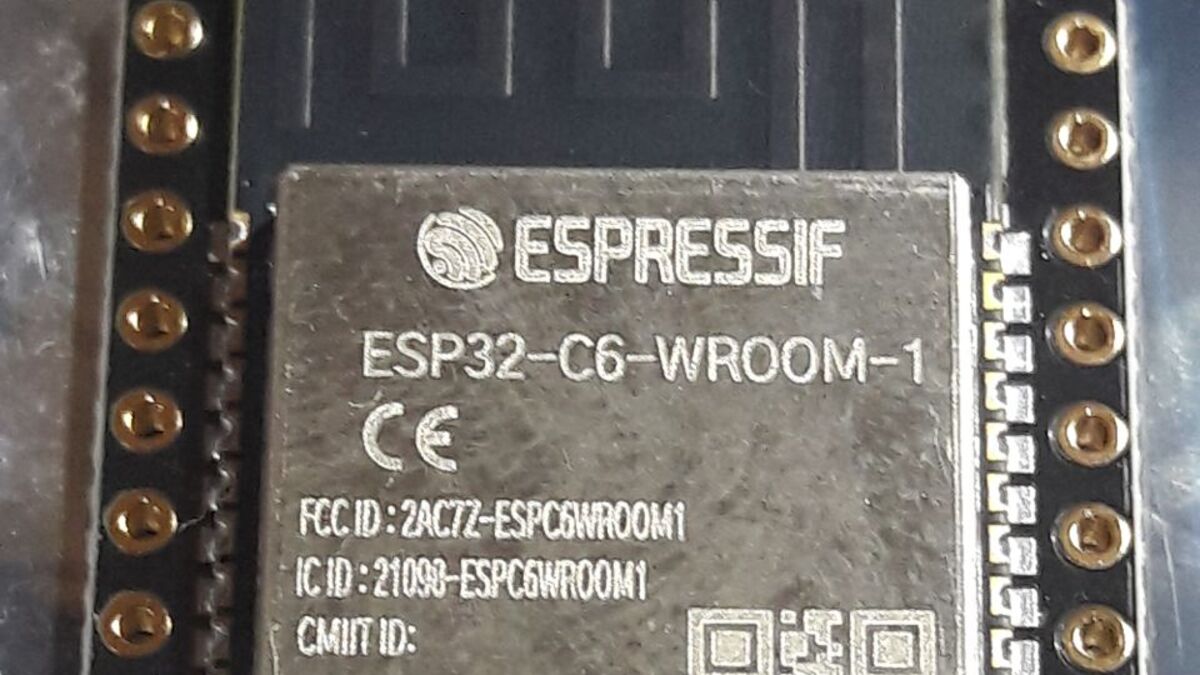
Two of Unexpected Maker's new Series[D] boards are on sale at Adafruit. The TinyC6[D] (Adafruit PID 6561) uses Espressif's ESP32-C6 and costs $24.95. The TinyPICO[D] (PID 6560) is a dual-antenna update of the original ESP32 TinyPICO and costs $27.95. Both product pages showed stock when we checked on November 18, 2026: 47 TinyC6[D] units and 43 TinyPICO[D] units. That makes both boards shipping retail products, not pre-orders or crowdfunding campaigns. Neither Adafruit nor Unexpected Maker gives an exact date the boards were added, so we cannot say when they first went on sale.
Unexpected Maker is the electronics business of Seon, who says on the homepage that the products are designed and made by him in Australia. The homepage lists the TinyC6[D], TinyPICO[D] and EdgeS3[D] II under "Meet the range" and says each Series[D] board has both an onboard and an external antenna, plus an I²C fuel gauge for battery monitoring. The maker's own product pages sit inside a JavaScript shop, and we could not extract detailed specs from them. The figures below come from Adafruit's spec tables and, for the chip itself, from Espressif's ESP32-C6 datasheet (v1.6).
One antenna on the board, one on a connector
The [D] suffix stands for the dual-antenna design. Adafruit's TinyPICO[D] listing describes an onboard antenna plus a u.FL connector for an external antenna, switchable from code. The same listing names an I2C fuel gauge and an ultra-low-power 1010 NeoPixel as the other main changes from earlier TinyPICO boards.
Adafruit's TinyC6[D] title also says "Dual Antenna", and its description repeats the same Series[D] upgrades: an onboard antenna and a u.FL connector switchable from code, an I2C fuel gauge and a 1010 RGB LED. Its spec table, however, lists a "3D high-gain antenna", VBAT checking and 5V presence detection, and does not mention the u.FL connector or the fuel gauge. The listing's description and its table are not perfectly aligned, so check the exact antenna and battery-monitoring hardware with the maker before buying for either feature.
TinyC6[D]: what the spec table says
Adafruit's specification table for PID 6561 lists:
- SoC: ESP32-C6, a 32-bit 160 MHz RISC-V core plus a 20 MHz low-power core
- Memory: 8 MB QSPI flash, no PSRAM
- I/O: 17 GPIO
- Radios: Wi-Fi 6 (2.4 GHz, 802.11ax); BLE 5.3 with Mesh; Zigbee and Thread (802.15.4)
- USB: USB-C for power, programming, serial UART and Serial/JTAG, with reverse USB back-feed protection
- Power: 700 mA 3.3 V regulator; LiPo charging with JST PH pads on the back; VBAT check and 5V presence detection; deep sleep as low as 20 µA per the description
- Indicator: low-power RGB LED
- Antenna: 3D high-gain antenna
- Footprint: compatible with TinyPICO, TinyS2 and TinyS3
- Size: 36.3 x 17.8 mm, 4.3 mm thick at the USB-C end. Adafruit separately gives product dimensions of 38.1 x 17.7 x 4.3 mm and a weight of 2.2 g.
- In the box: MicroPython pre-installed, plus unassembled male headers and a JST PH connector
Espressif's datasheet agrees with the main chip specs. It describes the ESP32-C6 as a 2.4 GHz Wi-Fi 6 (802.11ax), Bluetooth 5 (LE), Zigbee and Thread (802.15.4) part. It has a high-performance 32-bit RISC-V core running at up to 160 MHz, a separate low-power RISC-V core, and 512 KB of HP SRAM. Depending on the variant, the chip exposes 30 or 22 GPIOs and comes in a 5 x 5 mm QFN40 or QFN32 package. The board brings out 17 of them. Espressif's datasheet says "Bluetooth 5 (LE)", while Adafruit's table says "BLE 5.3". The two documents label the version differently, and we have not tried to reconcile them.
A copy-paste error worth knowing about
Adafruit's description text for the TinyC6[D] mentions the ESP32's "dual-core 240MHz" processor and calls the board "the TinyPICO you know". That wording comes from the TinyPICO listing and describes the original ESP32. It does not fit this board. Both Adafruit's own spec table and Espressif's datasheet describe the ESP32-C6 as one high-performance RISC-V core at up to 160 MHz, plus a low-power core that the spec table lists at 20 MHz. If you are planning firmware around two application cores, or comparing clock speeds against an S3, use the spec table and the datasheet.
TinyPICO[D]: the original form factor, updated
Adafruit's specification table for PID 6560 lists an ESP32-PICO-D4 (dual-core LX6, up to 240 MHz) with 4 MB QSPI flash and 4 MB QSPI PSRAM, 14 GPIO, Wi-Fi 802.11b/g/n and Classic Bluetooth plus BLE 4.2, USB-to-serial programming, a 700 mA 3.3 V regulator, LiPo charging with an I²C fuel gauge, an ultra-low-power RGB LED, a 3D high-gain antenna with a u.FL connector and software switching, and a 36.3 x 17.8 mm board that is 4.3 mm thick. The description adds MicroPython pre-installed, a USB-C port and a deep-sleep rating of 20 µA.
The two boards suit different projects. The TinyPICO[D] has PSRAM and the original ESP32, which suits code that needs large buffers, such as display frame buffers, audio, or MicroPython projects that use a lot of heap. The TinyC6[D] has no PSRAM and costs $3 less, but it adds Wi-Fi 6 and an 802.15.4 radio for Thread and Zigbee. It also has three more GPIO than the TinyPICO[D] (17 against 14).
Side by side
- Price at Adafruit (November 18, 2026): TinyC6[D] $24.95; TinyPICO[D] $27.95
- SoC: ESP32-C6 (single HP RISC-V core at 160 MHz plus LP core) vs ESP32-PICO-D4 (dual-core, up to 240 MHz)
- Flash: 8 MB vs 4 MB
- PSRAM: none vs 4 MB
- GPIO: 17 vs 14
- 802.15.4 (Thread/Zigbee): yes vs not listed
- Regulator: 700 mA 3.3 V on both
- Deep sleep (rated): 20 µA on both
- Firmware out of the box: MicroPython on both
What It Means for Makers
The dual-antenna design matters most when the board ends up inside a metal enclosure, behind a panel, or somewhere the onboard antenna can't reach the access point. Adafruit's TinyPICO[D] listing says the antenna is switchable from code, which would mean you don't have to buy a different board variant or move a resistor with a soldering iron. Both boards come with MicroPython pre-installed and have rated deep-sleep figures, so they look aimed at battery-powered sensors and remote nodes. A fuel gauge is useful for the same reason: it can report charge state without needing a resistor divider on an ADC pin. As always, follow the maker's own documentation for battery connection. This article does not cover battery wiring.
The TinyC6[D] is the more interesting of the two for anyone building around Thread or Zigbee. Its spec table lists the same footprint as the TinyPICO, TinyS2 and TinyS3, so existing Unexpected Maker carrier boards and enclosures should, by that listing, accept it physically. Pin functions on a RISC-V C6 differ from those on an Xtensa ESP32, so check your pin mapping before reusing firmware. The TinyPICO[D] is for people who already like the TinyPICO and want PSRAM, the antenna option and the fuel gauge in the same small format.
Both boards showed stock at Adafruit at the prices above on November 18, 2026. Unexpected Maker's own site lists both in its Series[D] range alongside the EdgeS3[D] II. We could not find readable independent coverage when we wrote this, so the spec claims here rest on Adafruit's listings and Espressif's datasheet. Where Adafruit's description text and spec table disagree, as with the TinyC6[D]'s "dual-core 240MHz" line, trust the spec table and the datasheet.
