
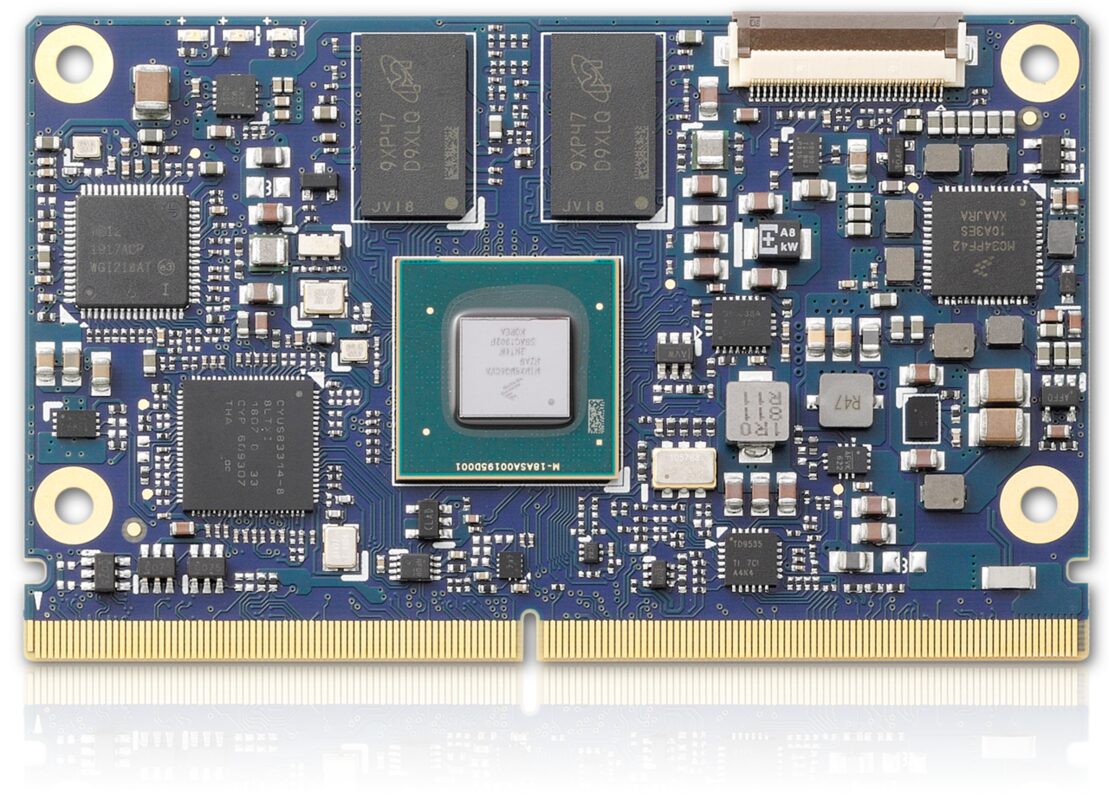
Vantron has put NXP's new i.MX 952 on a SMARC 2.1 module. The company announced the VT-SBC-SMARC-IMX952 at electronica 2026 in Munich, in a press release dated November 10. It is pitched at edge AI vision and industrial HMI. CNX Software covered it on November 13 and said it is the first SMARC module it has seen built on the i.MX 952. The module measures 82 x 50 mm and comes with 8GB of LPDDR4x, 64GB of eMMC, one Gigabit and one 2.5 Gigabit Ethernet port (both with TSN), and Android and Yocto Linux builds. Vantron has not published a price or an availability date.
The SoC: four application cores, two microcontrollers, one NPU
Most of what makes this module interesting comes from the i.MX 952 itself. CNX Software lists these specs for the version on Vantron's module:
- Application cores: dual- or quad-core Arm Cortex-A55 up to 1.7 GHz
- Real-time core: Arm Cortex-M7 at 800 MHz
- Safety core: Arm Cortex-M33 at 333 MHz
- GPU: Arm Mali-G310 with OpenGL ES 3.2, Vulkan 1.2 and OpenCL 3.0
- ISP: 500 MPixel/s
- NPU: eIQ Neutron, up to 2 TOPS (INT8)
Vantron's product page describes this as a "quad/dual-core CPU + two MCUs" with a dedicated NPU and GPU. The press release says the i.MX 952 supports functional safety under IEC 61508 and ISO 26262 up to SIL 2/ASIL-B and includes NXP's EdgeLock secure enclave. That is a statement about the silicon's safety and security features. The sources do not say the Vantron module itself has been certified to any safety level, so integrators should not read it that way.
The Zephyr Project's documentation for NXP's i.MX952 EVK gives a useful view from the microcontroller side. Zephyr calls the SoC mimx9529 and describes it as up to four Cortex-A55 cores plus a Cortex-M33 and a Cortex-M7 for functional safety. Its board target runs on the M7 core (imx952_evk/mimx9529/m7). This support is for NXP's EVK, which has 128 Gbit of LPDDR5, 64GB of eMMC and 1 Gbit of octal flash. Vantron's sources do not mention Zephyr, so treat it as evidence of what the SoC can do, not as a supported configuration of this module.
Memory, storage and the edge connector
CNX Software lists 8GB of LPDDR4x and 64GB of eMMC 5.1, and the press release gives the same capacities. Both ordering variants named so far use 8GB/64GB. No smaller or larger memory options have been announced. The module plugs into a carrier board through the standard SMARC 314-pin MXM 3.0 edge connector.
Display, camera and video
Vantron says the module can drive up to two displays at once over MIPI DSI and LVDS. The product page and CNX specify that the two displays run in duplicate mode, so do not assume two independent screens. CNX Software lists these display options:
- LVDS: 2x 4-lane or 1x 8-lane, up to 1920x1080@60
- MIPI DSI/HDMI: 4-lane, up to 4K30 or 3840x1440@60
- Camera: 1x 4-lane or 2x 2-lane MIPI CSI
Both the product page and the press release quote 4K 30P H.264 encoding and 4K 60P H.265/H.264 decoding. Vantron and CNX both write the DSI output as "MIPI DSI/HDMI", which suggests HDMI is available through the same interface. The sources do not explain how, for example whether the carrier board needs a bridge chip. Check the datasheet before planning an HDMI-only design.
Networking and I/O
Networking is the main reason this module stands out. The press release lists one GbE and one 2.5GbE port, both with Time-Sensitive Networking (TSN). For industrial controllers and machine-vision cells that share a deterministic network with motion hardware, two TSN ports on one module could save adding a separate TSN switch or NIC. Wireless is optional. The press release and CNX list Wi-Fi 5 and Bluetooth 5.0.
CNX Software lists the following I/O at the edge connector:
- 2x USB 2.0
- 3x UART (1.8V) plus a debug UART (1.8V)
- 2x CAN FD
- 2x SPI
- 2x I2C
- PCIe 3.0 x1
- 8x 12-bit ADC
- Up to 13 GPIO
- SD/SDIO 3.0
Note that the USB is 2.0 only. CNX lists no USB 3.x. Anything that needs high bandwidth, such as an NVMe drive, a faster radio or a second NIC, would have to use the single PCIe 3.0 lane. The UARTs run at 1.8V, so a typical 3.3V USB-serial adapter will need level shifting.
Power, temperature and software
CNX gives the power input as 5V/2.4A, with consumption up to 10W at full load. The press release lists an operating range of 0 to +70°C, with an optional -40°C to +85°C range. It does not say whether the wide-temperature option is a separate SKU.
Software is split across two ordering variants, per CNX's reading of the datasheet: VT-SBC-SMARC-IMX952-A for Android and VT-SBC-SMARC-IMX952-Y for Yocto Linux, both with 8GB/64GB. The press release also offers Vantron's BlueSphere MDM (mobile device management) as an option on Android. That matters more to someone deploying a fleet of HMI panels than to someone building one prototype.
How it compares with CompuLab's i.MX 952 module
Vantron is not the first company to build a module on this chip. In September 2026, LinuxGizmos reported on CompuLab's UCM-iMX952, which uses a different, much smaller format: 28 x 40 mm. It has the same dual- or quad-core Cortex-A55 up to 1.7 GHz, but supports up to 16GB of LPDDR5/LPDDR4X and 128GB of eMMC, along with PCIe Gen 3, 2.5GbE, Wi-Fi 6 and Bluetooth 5.4.
On paper, CompuLab offers more memory and newer radios, while Vantron offers the SMARC standard and two TSN Ethernet ports. The SMARC part matters. A SMARC 2.1 module is meant to fit SMARC carrier boards and be interchangeable with other vendors' SMARC modules, as long as the carrier's pin usage matches. CompuLab's module is a different size and, per LinuxGizmos, comes with its own SB-UCM-iMX95 carrier board. If you already have SMARC carriers in production, Vantron's module looks like an easier way to move to the i.MX 952, though the sources do not say which carriers it has been tested with.
What It Means for Makers
This is not a hobby board. It is a compute module for companies building industrial HMIs, machine-vision boxes and gateways, and it only works with a SMARC carrier board. The people who should pay attention are embedded engineers already using SMARC, and small hardware teams looking for an i.MX 9-class part with a safety-oriented microcontroller core on the same chip. The combination of a Cortex-M7 and Cortex-M33 next to the Linux cores means one SoC can in principle handle a real-time control loop or a watchdog/safety supervisor alongside the UI and the vision pipeline, rather than adding a separate MCU for that.
For individual makers, the i.MX 952 is more interesting than this particular module. Zephyr already supports NXP's i.MX952 EVK on the M7 core, so the chip is a realistic option for anyone who wants to experiment with mixing a Linux application processor and an RTOS on one die. The 2 TOPS NPU is modest next to dedicated accelerators, and Vantron pairs it with a 500 MPixel/s ISP for camera-based designs.
Price and availability: Vantron announced the VT-SBC-SMARC-IMX952 at electronica 2026 on November 10, 2026. Neither the press release nor CNX Software's coverage gives a price, and no availability or shipping date has been published. Treat it as an announced product, not one you can order yet. Anyone interested will probably need to contact Vantron sales for samples and to find out which carrier boards are supported.
Sources
- Vantron VT-SBC-SMARC-IMX952 i.MX 952 Computer-on-Module (Vantron product page)
- Vantron Launches i.MX 952 SMARC Module for Edge AI Vision and Industrial HMI at electronica 2026 (Vantron press release, Nov 10, 2026)
- Vantron unveils i.MX 952 SMARC system-on-module for Edge AI Vision and Industrial HMI at Electronica 2026 (CNX Software)
- i.MX952 Linux-capable module showcases 2.5GbE, Wi-Fi 6 and PCIe Gen 3 (LinuxGizmos)
- NXP i.MX952 EVK (Zephyr Project documentation)
