
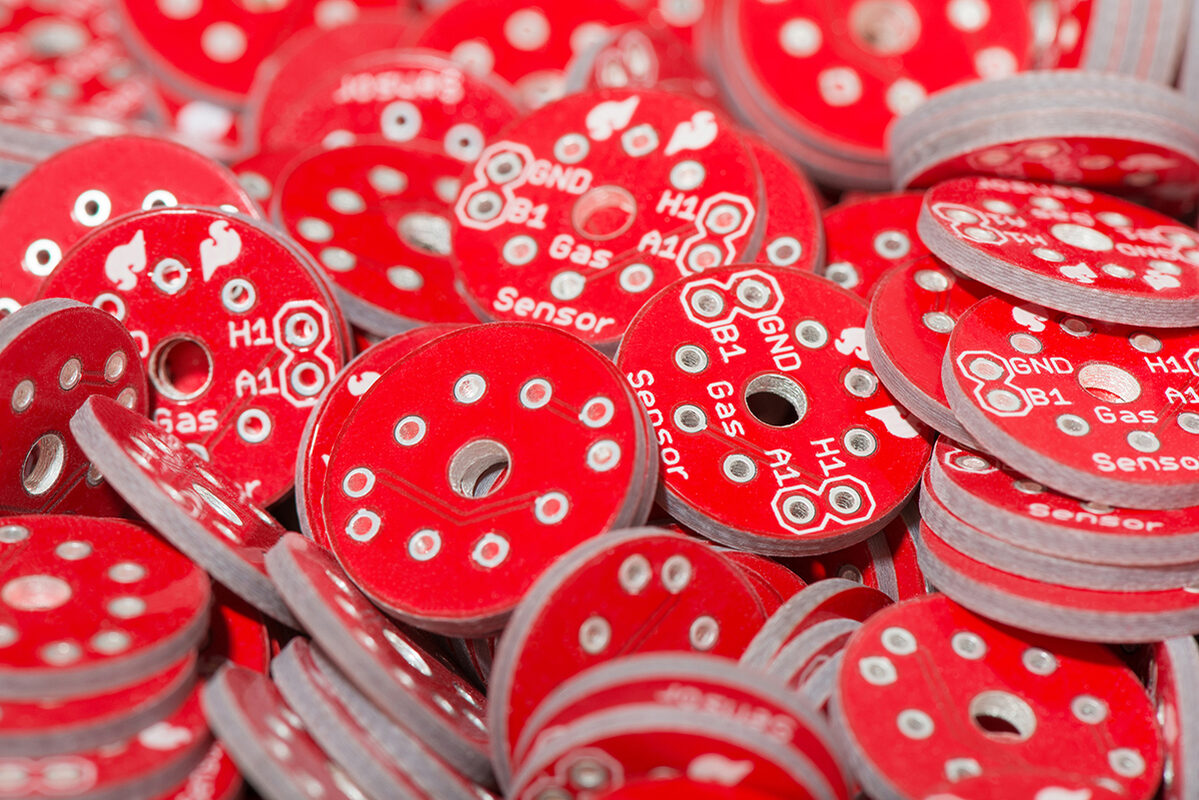
SparkFun used its weekly new-product post on 13 November 2026, titled "Cooking with Gas (Sensors) and Portable Power", to add nine gas-sensing breakouts to its Qwiic ecosystem. All nine use parts from Winsen's GM-XX2B MEMS series and share a 1-inch by 1-inch Qwiic footprint. Each board has an onboard ADC, so the sensor's analog signal reaches the host as a digital I2C reading. Prices in the launch post run from $10.95 to $13.95 (USD).
The headline matters less than one sentence on SparkFun's own product page. These boards do not report gas concentration out of the box. Below we cover what the boards are, what they measure, and what that caveat means for anyone planning to put a number on a display.
The Lineup
SparkFun's news post lists the nine boards with these part numbers and prices:
- GM-102B, nitrogen dioxide (NO2): SEN-32064, $11.95
- GM-202B, ethanol and smoke: SEN-32065, $11.95
- GM-302B, alcohol/ethanol: SEN-32066, $10.95
- GM-402B, combustible gases (methane, propane): SEN-32067, $10.95
- GM-502B, VOCs (ethanol, acetone, formaldehyde, benzene): SEN-32068, $10.95
- GM-512B, "Bad Breath" (H2S, NH3, acetone, alcohol): SEN-32069, $13.95
- GM-602B, hydrogen sulfide (H2S): SEN-31734, $11.95
- GM-702B, carbon monoxide (CO): SEN-32070, $11.95
- GM-802B, ammonia (NH3): SEN-32071, $11.95
The H2S board's number, SEN-31734, sits outside the SEN-3206x/3207x block the other eight share. That suggests it entered SparkFun's catalogue separately, though the post doesn't say.
How the Boards Work
SparkFun's hookup guide on docs.sparkfun.com calls the GM-XX2B parts metal-oxide semiconductor sensors. Their analog output rises with gas concentration, except on the GM-102B NO2 sensor, where it falls. Each breakout feeds that signal into an onboard 10-bit ADC, and the host reads the ADC over I2C through the Qwiic connectors. One guide covers all nine boards. Its example hardware is SparkFun's IoT RedBoard ESP32-P4 and ESP32-C5. The guide has Quick Start, Hardware, Software and Resources sections, and the Resources section carries KiCad files, schematics and datasheets.
The ammonia board's product page gives the most detailed electrical picture. SparkFun hasn't published the same figures for every variant here, so read the following as GM-802B specs only:
- Sensor: Winsen GM-802B MEMS, detection range 1 to 300 ppm ammonia
- Sensing element: resistance of 1 kOhm to 30 kOhm
- Heater: 80 Ohm ±20 Ohm at room temperature, under 45 mW, powered by an onboard LDO regulator
- Interface: analog output into an onboard 10-bit ADC, read digitally over I2C. Default I2C address is 0x5A
- Connectors: two Qwiic connectors, plus 0.1-inch plated through-holes for 3.3V, I2C, the ADC Alert line and the raw VOUT analog signal
- Software: the SparkFun GM-XX2B Arduino Library
- Design files: the product page lists a schematic and KiCad files
Breaking out raw VOUT means you aren't stuck with the onboard converter. If 10 bits is too coarse for your range, or you want to log the sensor on an ADC you've already characterised, you can tap the analog signal directly. The ADC Alert pin also opens up threshold-triggered interrupts, so the host doesn't have to poll. The library's README lists hardware gas-threshold alerts with programmable limits and hysteresis, plus an open-drain ALERT pin option.
The 0x5A address comes from the GM-802B page. The sources we read don't say whether the other eight boards share it, or whether the address can be changed. Builders who want several of these on one Qwiic bus should check each board's hookup guide and schematic before planning around them.
The Caveat: Qualitative, Not Quantitative
The ammonia board's product page is direct about it. The board returns only qualitative data, the baseline is uncalibrated, and the sensor has crossover to other gases. SparkFun advises calibrating against known NH3 concentrations if you need meaningful readings.
The launch post describes the boards as providing readings in ppm, but the GM-802B product page says its data does not represent a specific concentration in ppm. We go with the product page. The library's README also says it includes no conversion curves. That is normal for metal-oxide gas sensors, and it's fair of SparkFun to say so up front. In practice:
- A raw ADC count is not ppm. The "1 to 300 ppm" figure is the sensor's detection range, not a calibrated output. Turning counts into concentration takes a reference gas at known levels and a curve fitted to your own unit.
- Cross-sensitivity is built in. Some boards are designed to respond to several gases. The VOC board lists ethanol, acetone, formaldehyde and benzene, and the "Bad Breath" board lists H2S, NH3, acetone and alcohol. A higher reading tells you something changed, not which gas changed it.
- The heater is part of the measurement. The sensing element runs heated, so the board draws continuous power while sampling (under 45 mW on the GM-802B, per SparkFun) and needs a stable supply.
- NO2 reads backwards. On the GM-102B, a higher concentration lowers the analog output, according to the hookup guide. The library's README says it handles the direction for each part, but code that reads raw counts needs the inversion on the NO2 board.
These are good for spotting trends and detecting events, like "the air in this room changed" or "something is off-gassing near the printer enclosure". They are not instruments. A CO or combustible-gas breakout shouldn't stand in for a certified alarm.
What It Means for Makers
The main audience is people who already use Qwiic or STEMMA QT-style I2C chains and want a gas channel without hand-wiring a MOS sensor, heater regulator and ADC front end. Because the boards share a footprint and one library, the gas is easy to swap. A classroom or prototype can start with the $10.95 alcohol board and move to the CO or H2S variant without changing the mechanical or software design much. Educators get a cheap way to show how metal-oxide sensing and cross-sensitivity behave. The calibration problem is itself a good lab exercise.
For embedded engineers, the open KiCad files and the raw VOUT breakout make the boards a practical reference design for evaluating Winsen's GM-XX2B parts before committing one to a custom PCB. Anyone needing calibrated ppm readings should budget for reference-gas calibration, or choose a factory-calibrated sensor module instead.
Pricing and status, from SparkFun's 13 November 2026 post: all nine boards are listed as new products at launch prices of $10.95 (GM-302B, GM-402B, GM-502B), $11.95 (GM-102B, GM-202B, GM-602B, GM-702B, GM-802B) and $13.95 (GM-512B), in USD. The same post notes SparkFun's November Deals sale is ongoing, with week three (from 16 November) discounting development boards.
Also in the Post: Rechargeable Cells
The other half of SparkFun's post adds five rechargeable battery options: a PKCELL NiMH AA 4-pack (2800 mAh, $14.95), a NiMH AAA 4-pack (1200 mAh, PRT-32196, rated for up to 1,000 cycles), a 9V NiMH cell, and USB-C rechargeable lithium AA and AAA packs. These are consumables and nothing in the post describes hardware design. We're only noting them here.
