
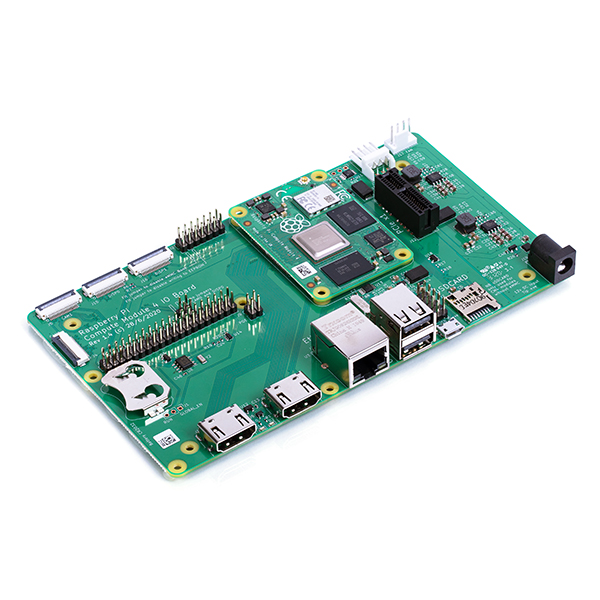
Anyone who has fed HDMI into a Raspberry Pi camera port knows the usual limit. The common Toshiba TC358743 bridge boards top out at 1080p, at 30 to 60 frames per second depending on the board, according to CircuitDigest. WarpKVM has published an open-hardware alternative built on the Rockchip RK628H. On a Raspberry Pi Compute Module 4 with all four CSI-2 lanes connected, the maker reports 4K at 30 fps and 1080p at 120 fps.
CircuitDigest covered the rk628-bridge-boards repository on 14 November 2026. Hackaday followed on 21 November. The design itself is therefore about a week older than the latest coverage. What the extra week adds is a clearer view of the limits: which hosts get which lane counts, and which of the three boards actually exists as hardware.
Three boards, one bridge chip
All three designs use the RK628H to turn an HDMI input into a MIPI CSI-2 output. WarpKVM's documentation describes them as "Open hardware RK628H bridges that capture HDMI over MIPI CSI-2, from 1080p120 to 4K60, with EDID control." The repository README notes that the RK628D also works on the single-link boards. The figures below come from the maker's own table.
- rk628-22p: a 22-pin, 0.5 mm-pitch FPC connector with the Raspberry Pi camera pinout, according to WarpKVM's docs. It carries 4 CSI-2 lanes and is rated for 4K30 and 1080p120. It has an I2S audio header and measures 45 x 30 mm. The README lists it as tested on the Luckfox Aura (RV1126B), the Raspberry Pi CM4 and the Pi 4B, with the Pi 4B qualified by its lane count. This board has been built and tested.
- rk628-30p: a 30-pin FPC connector, 4 lanes, and an on-board DAC with a 3.5 mm jack. It measures 46.25 x 30 mm and is tested on the Firefly ROC-RK3576-PC.
- rk628-2x22p: two 22-pin FPC connectors carrying 2 x 4 lanes, rated for 4K60, at 49 x 32.5 mm. The docs list the Luckfox Aura as its host. The README marks it "Not yet fabricated." The circuit has so far been captured on a DIY shield rather than a finished board.
That last entry matters. The 4K60 in the docs' headline range ("1080p120 to 4K60") belongs to a board that has not been fabricated. The single-link boards that have been built are what deliver the 4K30 and 1080p120 figures.
Why lane count sets the ceiling
The RK628H can output four CSI-2 lanes, but the host has to have them. CircuitDigest reports that the Raspberry Pi 4B exposes only two camera lanes. On that board the 22-pin bridge tops out at 1080p60, and you need a 22-pin to 15-pin cable to reach the Pi's standard camera connector. The CM4 exposes four lanes, and that is where CircuitDigest says the 22-pin board measured 4K30 and 1080p120.
CircuitDigest compares those figures with the TC358743 boards' own ratings: 1080p50 for 2-lane boards and 1080p60 for 4-lane boards. So a four-lane RK628H board on a CM4 doubles the 1080p frame rate of the best TC358743 option and adds a 4K mode. On a two-lane Pi 4B the gain over a TC358743 board is small, at most moving from 1080p50 to 1080p60.
CircuitDigest says the Raspberry Pi 5 has not been tested yet. Pi 5 owners should treat support as unknown for now.
Hackaday's write-up describes the variants a little differently. It mentions 1-lane and 2-lane options and groups the Raspberry Pi 4 with the CM4. This article uses the maker's table for lane counts and host lists.
The driver work
The hardware is only part of the release. CircuitDigest reports three problems with the stock Rockchip driver. It ignored EDID changes until the cable was unplugged and replugged. It never advertised audio. And it could lock up the bridge after a hot replug. The WarpKVM README lists matching fixes: live EDID changes, HDMI audio advertisement, recovery from hot-replug lockups, and removal of a lane-rate cap on chips that do not need it.
For a capture device, these are basic behaviours. EDID is how the bridge tells the HDMI source which resolutions and refresh rates it accepts. If changes only take effect after a replug, a remotely managed system needs someone to unplug a cable. A bridge that locks up after a hot replug is a bigger problem for anything meant to run unattended, such as a KVM, which is the product category the maker's name points to.
According to WarpKVM's docs, the repository holds the schematics, CAD files, Gerbers, BOMs, kernel patches and installers. Hardware is licensed under CERN-OHL-S-2.0 and software under GPL-2.0. CERN-OHL-S is the strongly reciprocal variant of the CERN Open Hardware Licence, so modified versions of the board that are distributed must also share their design sources.
An ESP32-P4 footnote
Hackaday points to an earlier HDMI-to-CSI project for the ESP32-P4 and suggests its drivers may help anyone trying to pair the P4 with this hardware. Hackaday notes that the P4's CSI interface was intentionally designed to be electrically the same as the Raspberry Pi's. That is Hackaday's suggestion, not a host WarpKVM has tested, and the maker's table does not list the P4.
CircuitDigest also reports that WarpKVM shared a CM4-format RV1126B vision module earlier the same week. The RV1126B is the chip in the Luckfox Aura, one of the 22-pin board's tested hosts.
What It Means for Makers
The main audience is people building HDMI capture into a Linux SBC: IP-KVM builders, people streaming or recording a console or camera feed, and anyone using a CM4 carrier for video ingest who has hit the TC358743's 1080p limit. On a CM4 carrier that routes all four camera lanes, the rk628-22p is the board to look at, with 4K30 and 1080p120 measured according to CircuitDigest. The rk628-30p targets the Firefly ROC-RK3576-PC and adds analog audio out through its on-board DAC and 3.5 mm jack.
Pi 4B owners can use the 22-pin board with a 22-pin to 15-pin cable, but the two lanes limit it to 1080p60. If 4K or high-frame-rate 1080p is the goal, a four-lane host is what you need. Pi 5 support has not been tested.
On availability: the sources describe this as an open design release with full fabrication files, not a retail product. None of the four pages I read lists a price for assembled boards, and the repository publishes Gerbers, BOMs and pick-and-place files, so expect to have the PCBs fabricated and assembled yourself. Two boards have been built and tested on their listed hosts: the rk628-22p and the rk628-30p. The rk628-2x22p for 4K60 exists only as a design and has not been fabricated. The kernel patches and installers are in the same repository under GPL-2.0.
