
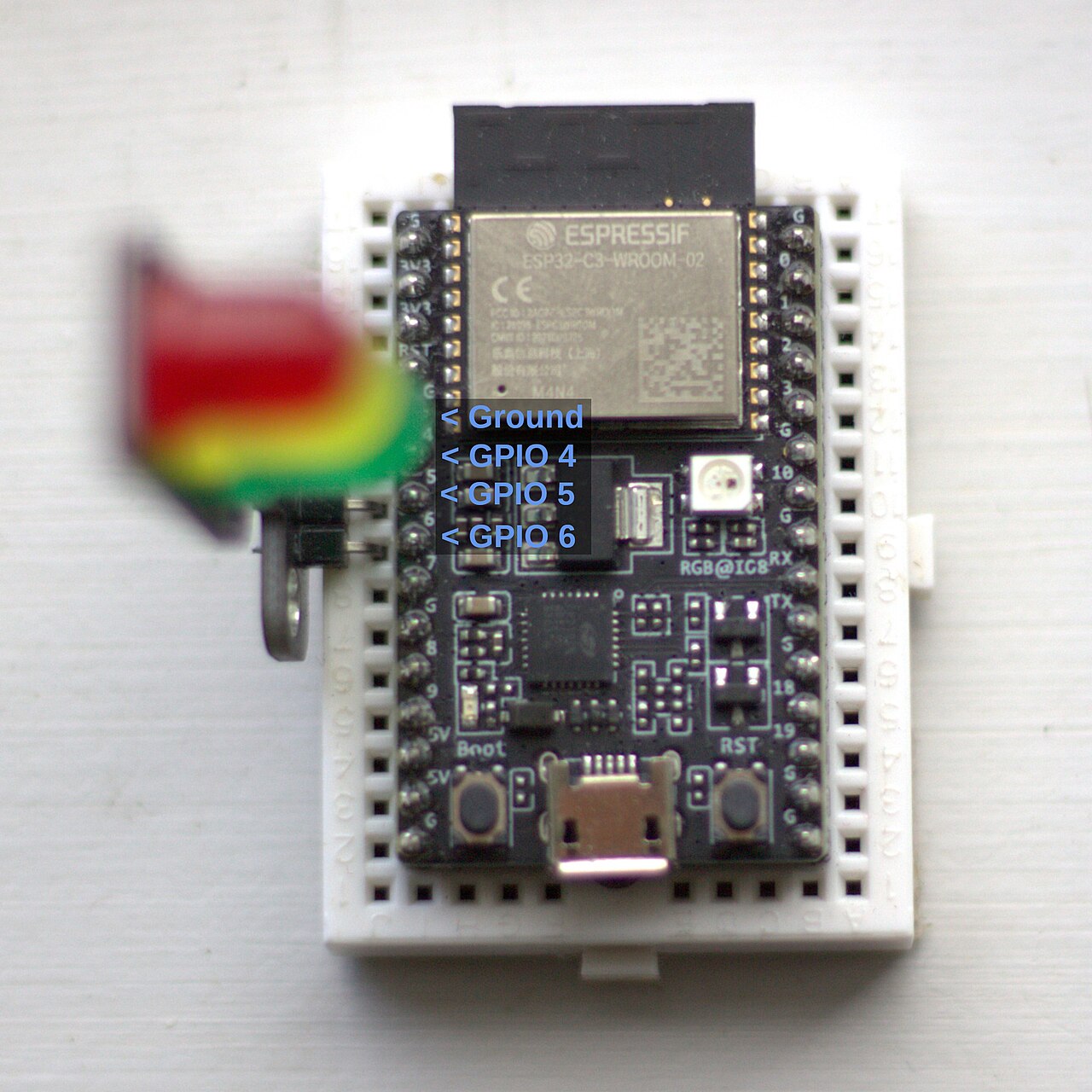
Waveshare has added a Zero-form-factor board for Espressif's new ESP32-S31. The ESP32-S31-Zero is a small module-style dev board with castellated edges, a USB Type-C port and a 40-pin board-to-board connector for displays, touch and SD storage. Our earlier ESP32-S31 coverage looked at the Guition and Viewe boards. This is a different product: a bare compute board for embedding, not a display kit.
The chip is new enough that some of the board's specs are still provisional, so it helps to separate what Waveshare has published, what Espressif states for the silicon, and what independent coverage has added.
The silicon: what Espressif says about the ESP32-S31
On its product page, Espressif describes the ESP32-S31 as a dual-core 32-bit RISC-V SoC running at 320 MHz with an MMU. It quotes 6.86 CoreMark/MHz and says one of the two cores has a 128-bit data path with SIMD. Memory is listed as 512 KB of SRAM plus support for 250 MHz 8-bit DDR PSRAM.
The radio list is long for an ESP32 part: 2.4 GHz Wi-Fi 6, IEEE 802.15.4 for Thread and Zigbee, and Bluetooth 5.4 LE with LE Audio, Direction Finding and Mesh 1.1, plus Bluetooth Classic (BR/EDR). Espressif also lists a 1000 Mbps Ethernet MAC, a DVP camera interface, an LCD interface supporting 8- to 24-bit parallel RGB and I8080, up to 14 capacitive touch channels, a JPEG codec, a PPA and 2D-DMA. On security, it lists a TRNG, a RAM-based PUF, secure boot, and flash and PSRAM encryption. The chip has 60 GPIOs.
The Zero board brings out only a small part of that.
The board: what Waveshare lists
Waveshare's documentation describes the processor as a 32-bit RISC-V dual-core up to 320 MHz with 512 KB SRAM. Wireless is listed as 2.4 GHz Wi-Fi 6, Bluetooth 5.4 (LE), Classic BR/EDR and IEEE 802.15.4 (Thread/Zigbee). The product page gives the Wi-Fi standards as 802.11 b/g/n/ax.
Onboard hardware, according to Waveshare:
- USB Type-C for firmware download and console through the chip's USB Serial/JTAG interface
- WS2812B-1010 addressable RGB LED
- BOOT and RESET buttons
- Castellated holes exposing 15 GPIOs
- 40-pin connector for an RGB LCD, touch and SD card
- MP1605GTF-Z DC-DC converter for the 3.3 V rail
- Either an onboard SMD antenna or an IPEX-4 connector, depending on version
CNX Software adds physical details. The board measures 28 x 18 mm, which CNX notes is slightly longer than some other Zero boards measuring 25 x 18 mm. It has eighteen through/castellated holes and two 9-pin header rows. CNX counts up to 15 GPIOs, UART, six ADC inputs, a 5 V Vin pin and a 3.3 V output on those headers.
Peripheral counts are provisional
Waveshare's doc lists 6 SPI, 2 I2C, 4 UART, 2 I2S, two 12-bit SAR ADCs (up to 16 channels) and 2 DACs. It also states that these figures come from the pre-release ESP32-S31 datasheet v0.5 and represent chip-level resources; what is actually available depends on the board's exposed pins, multiplexing and SDK support. Treat them as subject to change until Espressif publishes a final datasheet. Anyone planning a design around a specific peripheral count should check it against the final document.
A Bluetooth version discrepancy
CNX's article calls the radio Bluetooth 5.3 in its introduction and Bluetooth 5.4 in its spec list. Waveshare's documentation, Waveshare's product page and Espressif's chip page all say Bluetooth 5.4 LE. We are going with the maker and the chip vendor.
Eight SKUs, one reported in stock
Waveshare lists four memory combinations: N16R16, N32R16, N16R32 and N32R32, covering 16 or 32 MB of flash and 16 or 32 MB of PSRAM. Each comes with or without a pre-soldered header, marked by an -M suffix, for eight variants in total. The product page's selector table matches: 16 MB/32 MB flash, 512 KB SRAM, 16 MB/32 MB PSRAM.
CNX reports that, as of its 7 November 2026 article, only the ESP32-S31-Zero-N32R16 with headers is available. CNX describes that variant as 32 MB PSRAM and 16 MB flash. Waveshare's naming runs the other way: its product page lists the N32RX models as 32 MB flash with 16 MB or 32 MB PSRAM, which would make the N32R16 a 32 MB flash, 16 MB PSRAM part. We cannot reconcile the two from the sources, so buyers who care about which figure applies to flash and which to PSRAM should confirm it on the listing they buy from.
The 40-pin connector and an Ethernet possibility
The B2B connector is the part that separates this board from a typical Zero clone. Waveshare positions it for an RGB LCD, a touch controller and an SD card, which matches the ESP32-S31's RGB LCD interface. Display-heavy projects can use a small compute board and a separate panel carrier without running a ribbon cable to castellated pads.
CNX points out that the chip's Gigabit Ethernet RGMII pins are multiplexed with GPIO8 to GPIO19, and that those pins reach the 40-pin connector. In principle, then, someone could build an Ethernet expansion board, using the chip's 1000 Mbps MAC that Espressif lists. Neither source says Waveshare has announced such an add-on, so for now this is a possibility, not a product.
Software: ESP-IDF v6.1, preview target
Waveshare provides 12 ESP-IDF examples covering GPIO, the RGB LED, the button, UART, I2C, Wi-Fi, BLE, and display, touch and SD peripheral tests. The examples target ESP-IDF v6.1. In that release the ESP32-S31 is a preview target, so it must be selected with the --preview parameter. Early adopters should expect toolchain and driver support to still be maturing.
CNX also notes that initial Linux support for the ESP32-S31 exists. That is a chip-level note, not a Waveshare deliverable for this board.
What It Means for Makers
The ESP32-S31-Zero is for people who want to try Espressif's newest multi-protocol chip on something small enough to solder into a finished project: a castellated board, a USB-C cable, no carrier needed. Compared with Wi-Fi 4 ESP32 Zero boards, it adds Wi-Fi 6, 802.15.4 for Thread and Zigbee, Bluetooth 5.4 LE alongside Classic, and up to 32 MB of PSRAM. That combination suits Matter-style home devices, small HMIs and audio projects that use BLE and Classic together.
The trade-offs are clear. Fifteen GPIOs on the castellated edge is a small slice of the chip's 60, so pin-hungry designs will either depend on the 40-pin connector or need a bigger board. Peripheral counts rest on a v0.5 pre-release datasheet, and the chip is a preview target in ESP-IDF v6.1. This is an early-adopter board, not a drop-in replacement for a mature ESP32-S3 design that has to ship next month.
Price and availability: According to CNX Software on 7 November 2026, the only variant currently available is the ESP32-S31-Zero-N32R16 with headers, at US$10.99 from the Waveshare store, US$12.23 on AliExpress and US$18.99 on Amazon. The other seven SKUs appear in Waveshare's documentation, but no source we read gives them a price or a date.
