
Shenzhen Wireless-Tag has a new ESP32-P4 development board, and this one is not on Kickstarter. The WT99P461-S1 is on sale at the company's own web shop for $21 (board only) or $42.50 as a kit with the WTDK-LCD-7D0M 7-inch display. Those are prices reported by CNX Software on November 4, 2026, and shipping and taxes are extra. The board puts an Espressif ESP32-P4 application processor and an ESP32-C61 radio companion on one 25 x 25 mm core module. Around it sits a carrier with a wide set of wired interfaces, including Fast Ethernet, RS-485, CAN, MIPI DSI and CSI, and USB in both Type-C and Type-A forms.
Most of the board's specs are clear. A few are not, and we flag those below. The two main sources, Wireless-Tag's own wiki and CNX Software's write-up, give different figures for the Bluetooth version and the CPU clock.
Two chips on one module
According to Wireless-Tag's board features documentation (doc v1.0.0, dated 2026-09-09), the board is built around the WT01P461-S1 core board. That module carries an Espressif ESP32-P4, which the wiki describes as a dual-core RISC-V processor running at 400MHz with 32MB PSRAM, and an ESP32-C61 that handles 2.4 GHz Wi-Fi 6 (802.11ax) and, per the wiki, "Bluetooth 5.0 LE" with Bluetooth Mesh 1.1 support.
The split is the usual one for P4 designs. Espressif's ESP32-P4 product page describes a high-performance SoC with dual-core RISC-V HP cores, an LP-core running at up to 40 MHz, MIPI-CSI and MIPI-DSI interfaces, H.264 encoding up to 1080p@30fps and a pixel processing accelerator (PPA). Espressif says that if an application needs wireless connectivity, a chip from the ESP32-C or S series can serve as a companion over SPI, SDIO or UART. Wireless-Tag's sample project on GitHub says the WT99P461-S1 gets its Wi-Fi and BLE from the on-module ESP32-C61 over full-duplex SPI through ESP-Hosted.
CNX gives more detail on the P4 side. It lists the dual RISC-V cores at 360/400 MHz, a low-power core at up to 40 MHz, 768 KB of HP L2MEM, 32 KB of LP SRAM, 8 KB of TCM and 32 MB of PSRAM, plus 16 MB of NOR flash. The flash capacity, L2MEM, TCM and LP SRAM figures come only from CNX. The wiki excerpt we checked does not list them.
Which P4 is it?
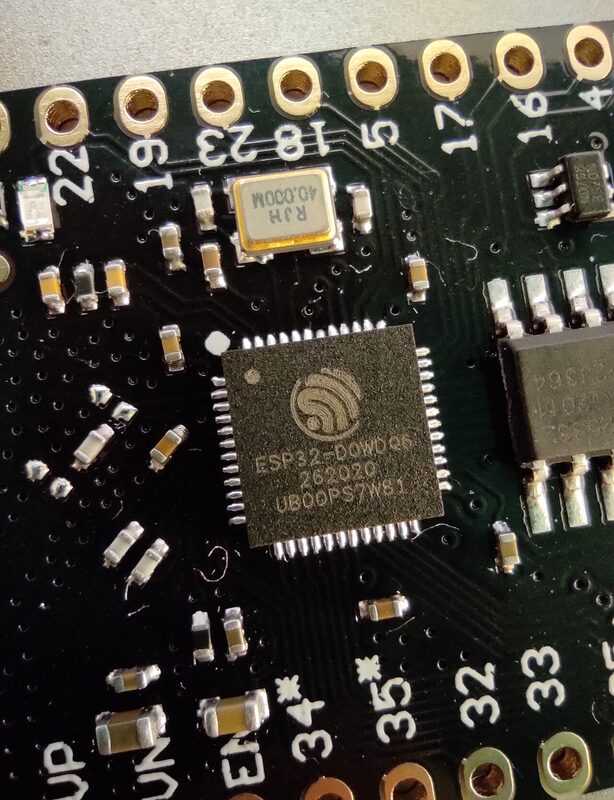
CNX calls the chip an "ESP32-P4X", which it identifies as ESP32-P4 v3.2. CNX also says the product page does not clearly state whether the module is based on the P4X or the ESP32-P4 v1.3. Wireless Tag confirmed to CNX by email that the module is now based on the ESP32-P4 v3.2 chip. The vendor wiki we reviewed says only "ESP32-P4". Buyers who need a specific silicon revision for errata or toolchain reasons should treat the email confirmation as the best evidence for now and check the marking on their own board when it arrives.
Spec conflicts to note
- Bluetooth version: the vendor wiki says the ESP32-C61 provides Bluetooth 5.0 LE with Mesh 1.1. CNX's spec list says both "Bluetooth 5" and "Bluetooth 5.4" for the same chip. PinoutFeed has not resolved this, and the vendor's own documentation currently says 5.0 LE.
- CPU clock: the wiki gives 400 MHz. CNX gives "360/400 MHz". The vendor documentation does not explain the difference.
- Silicon revision: per CNX, the product page does not clearly state P4X (v3.2) or v1.3. The v3.2 claim rests on an email from Wireless Tag to CNX.
The carrier board
The carrier is where this board differs from the small P4 dev kits. Wireless-Tag's wiki lists the following, with connector designators:
- Ethernet: RJ45, 10/100 Mbps (J12)
- RS-485: J13, with an onboard PHY chip
- CAN: J17, with an onboard PHY chip
- USB: USB 2.0 Type-C full-speed OTG (J3), which can also power the board, and USB 2.0 Type-A high-speed OTG host (J4)
- Display: MIPI DSI on a 30-pin 0.5 mm FPC (J9), plus a 6-pin capacitive touch connector (J8)
- Camera: MIPI CSI on a 15-pin 1.0 mm FPC (J15)
- Storage: 4-bit microSD slot (J11)
- Audio: onboard microphone (MIC1) and a speaker connector rated for up to 4 ohm, 3.0 W (J7)
- Indicators: RGB LED on GPIO54 (D41)
- Programming: a C61-PROG header (J16) for flashing the ESP32-C61 directly
The wiki says all available pins on the core board are brought out to headers. CNX describes this as a 50-pin GPIO header, and also gives the board size as 120 x 90 mm and the power input as 5 V/2 A over USB-C. Note that "50-pin header" is a connector pin count, not a count of usable GPIOs. Neither source gives a free-GPIO number after the onboard peripherals are accounted for.
The PHYs on both RS-485 and CAN matter for anyone building industrial gateways or HMIs. Many P4 boards bring out only UART or TWAI signals and leave the transceiver to the user. Here both buses connect to PHY chips on the board.
Software
The wiki says both chips can be programmed with Espressif's ESP-IDF SDK, with serial flashing and debugging through ESP-TOOL. The board ships with demo firmware: CNX reports a preloaded ESP-Brookesia smartphone-style UI, support for an SC2336 camera, and MJPEG video playback. CNX says H.264 playback is not supported yet. That is a firmware limitation reported for the demo, and it should not be confused with the H.264 encoder Espressif lists for the chip.
The WT99P461_S1_1V1 GitHub repository holds the vendor sample project. It builds the ESP-Brookesia interface and includes media apps, a camera app, games, a calculator, and face and pedestrian detection demos. It is the obvious starting point for checking how the ESP-Hosted link to the C61 is set up before you write your own firmware.
Lineage
CNX notes that the WT99P461-S1 uses the same WT01P461-S1 module as the ESP32P4C61-TINY board, which was introduced last June through a Kickstarter campaign. The WT99P461-S1 is sold directly instead. For buyers, the difference is that this is a retail product on sale at the company's web shop with a listed price, not a pledge with an estimated delivery date.
What It Means for Makers
The WT99P461-S1 is aimed at people building HMI panels, small industrial controllers, camera-equipped edge devices and networked displays, where MIPI DSI/CSI and wired fieldbus interfaces are both needed. Without a board like this, that job usually means an ESP32-P4 dev kit plus separate Ethernet, RS-485 and CAN transceiver breakouts. Here all of it is on one 120 x 90 mm board (per CNX), with Wi-Fi 6 from the on-module ESP32-C61.
Educators and hobbyists who want to try the P4's display and camera pipeline also get a low-cost entry point. The $42.50 kit includes a 7-inch display, and CNX reports the demo firmware supports a 7-inch touchscreen. Anyone who needs H.264 playback today should note that CNX says the shipped firmware supports MJPEG only, with H.264 not supported yet.
Check the specs before designing around them. The vendor wiki and CNX disagree on Bluetooth (5.0 LE vs 5.4) and CPU clock (400 MHz vs 360/400 MHz). The ESP32-P4 v3.2 revision is confirmed only by Wireless Tag's email to CNX, not on the product page.
Price and availability: $21 board-only, or $42.50 with the WTDK-LCD-7D0M 7-inch display kit, as reported by CNX Software on 2026-11-04. It is sold directly at Wireless-Tag's own web shop, with shipping and taxes extra. It is not a crowdfunding campaign.
Sources
- WT99P461-S1 Board Features - wireless-tag Wiki (vendor documentation)
- $21 ESP32-P4X and ESP32-C61 full-featured board offers Ethernet, WiFi 6, RS485 CAN Bus, MIPI CSI/DSI, and more - CNX Software
- wireless-tag-com/WT99P461_S1_1V1 - sample project on GitHub
- ESP32-P4 High-performance SoC - Espressif Systems
