
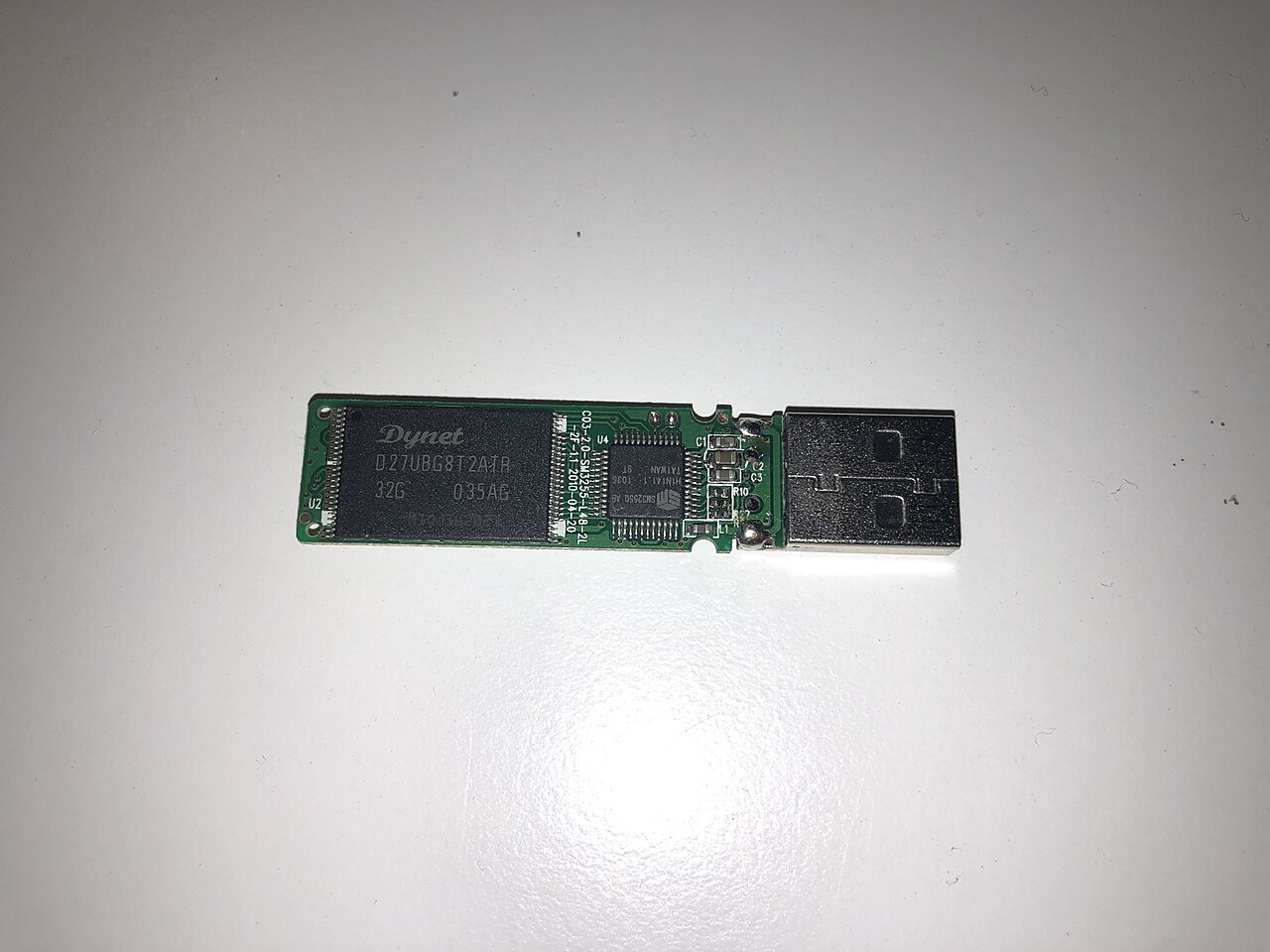
Doom has been ported to thermostats, electric toothbrushes and a long list of other gadgets. The latest port runs on a USB flash drive, and there is an unusual twist. The drive has no buttons, and the chip that runs the game cannot see the USB bus. So the controls come from file traffic: copying a file to the stick moves you forward, reading a file from it turns you right, and doing both at once fires.
The project comes from Aaron Christophel, who publishes as atc1441. He has posted the firmware, the build layer and a PC-side control script in a public GitHub repository. The target is the MOVESPEED MSSU10-128GSR, a 128 GB USB drive with a small built-in screen. Hackster.io and TechEBlog (dated 15 November 2026) have both covered the project, and both describe the same hardware.
Two chips, one stick
Christophel's write-up shows that the MSSU10 is really two devices sharing one enclosure. The storage side is a Silicon Motion SM2320G controller. The README describes it as a USB 3.2 Gen 2x2 part with four NAND channels. It handles everything the host computer sees, and the project does not modify it.
The display side is a separate microcontroller, a C*Core CCM4101. According to the repository, it is an Arm Cortex-M4F with 128 KiB of SRAM mapped at 0x1FFF8000. It also has 2 MiB of SPI NOR flash inside the CCM4101 package, memory-mapped at 0x10000000. It drives a 428x142 panel in RGB565 over SPI. TechEBlog independently confirms the split: the SM2320G handles USB and storage, and the CCM4101 Cortex-M4F, with 128 KB of RAM and 2 MB of flash, drives the display.
The clock speed is worth a closer look. According to the README, the datasheet and the stock firmware both claim 200 MHz. Christophel measured 40.2 MHz, and Hackster.io and TechEBlog both repeat that figure against the claimed 200 MHz. That is roughly a fifth of the advertised speed, so the Doom port had to fit a much smaller performance budget than the spec sheet suggests.
The two chips talk over bit-banged I2C, with the display controller at 7-bit address 0x0A. In the stock product, this link carries the status the storage controller reports to the screen. Doom uses the same link as its only input channel.
How file copies become controls
The CCM4101 has no USB connection, so it cannot receive keystrokes or HID reports from the host. All it gets is what the SM2320G sends over I2C, which includes counts of sector reads and writes. Christophel's firmware polls those counters every 50 milliseconds and decodes the rate of change into game input. Plain file copying, with no special software, maps to three commands:
- Write traffic (copying a file to the stick): walk forward
- Read traffic (reading a file from the stick): turn right
- Both at once: fire
Copying files by hand would be hard to control, so the repository includes a Python program, doomctl.py, that runs on the PC and paces the read and write traffic. The host computer and operating system see only normal storage activity. Hackster.io notes that once the firmware is installed, no extra hardware is needed to play.
Plain copying is crude, which is why the PC-side program exists. According to the README, doomctl.py turns arrow keys into read and write traffic at different rates, and the firmware sorts each direction into five levels. That unlocks the rest of the controls, including backward movement, left turns, strafing, the menu and weapon changes. Input latency is roughly 100 ms, so this is a demonstration of an unusual side channel rather than a comfortable way to play.
What runs, and how well
The firmware combines Artur Bieniek's DMC100-DOOM port with a board-specific layer for the MSSU10. Hackster.io reports about 13 frames per second, with game logic running at Doom's normal 35 ticks per second. Only E1M1 is included, because according to the README only one map fits in the flash alongside the engine and data. There is no sound, since the stick has no buzzer.
The repository includes prebuilt DOOM.BIN and DOOM.DAT files, so you do not have to set up a toolchain to try it.
Flashing: SWD pads, and dump first
Installing the firmware means reaching internal pads. According to the README, you need a J-Link or another SWD probe connected to four pads: SWCLK, SWDIO, GND and 3V3. The process overwrites only the display firmware. The SM2320G and its NAND are not touched, and the stick keeps working as a normal USB drive afterward.
Christophel advises dumping the stock 2 MiB display image before flashing. The README gives a flasher command that saves all 2 MiB, which is what you would need to go back to the original status screen. Anyone with data on the drive should also back it up before opening the case, even though the storage path is not modified.
What It Means for Makers
This project is mainly for people who enjoy reverse engineering and for embedded developers curious about the extra microcontrollers inside consumer gadgets. Its most useful lesson is not the Doom port itself. It is the documentation of a cheap retail device that contains a Cortex-M4F, 2 MiB of memory-mapped SPI NOR, a 428x142 color SPI panel and exposed SWD pads. With the memory map, I2C address and pad list in the repository, anyone with an SWD probe can start writing their own firmware for the display: custom status screens, small animations, or other low-bandwidth displays.
The control scheme is also worth studying as a technique. It shows that a component with no direct link to the host can still get input from it through a side effect that an intermediate controller already reports, here the sector read/write counts.
Before buying hardware, keep in mind:
- Required tools: an SWD debug probe (the README names J-Link as one option) and a way to reach the four pads.
- Specs to plan around: 40.2 MHz measured clock (the datasheet says 200 MHz), 128 KiB SRAM, 2 MiB flash, a 428x142 RGB565 panel and input from read/write activity only.
- Status: this is an open-source hobby project published on GitHub, with prebuilt binaries available now. It is not a commercial product, and the drive maker has not endorsed it.
- Price: none of the sources gives a price for the MSSU10-128GSR itself. TechEBlog's page, on 15 November 2026, carried an Amazon affiliate listing for a 128 GB MOVE SPEED drive with a smart display, described as 1090MB/s and USB 3.2 Gen2, showing $47.49 on sale (down from $52.99). That is a retailer listing, not a confirmed price for this model. Check that a listing matches the MSSU10-128GSR model number before buying, because the firmware is written for that board.
Do not expect a full game. This is one level at about 13 fps with no sound, played by copying files. As a documented hack that can be reversed with a dump of the stock firmware, it is more useful than most "Doom on X" projects.
