
Most retro handhelds that play DOS games are ARM boards running DOSBox. Jeroen Domburg, better known as Sprite_tm, went the other way. His VapourDeck is a Steam-Deck-style handheld built around an actual 486 CPU. In his words it plays DOS games with "no emulation", on "a custom 486-powered system". He has published a five-page write-up on SpritesMods and put the design files on Codeberg. Hackaday covered the project on 15 November 2026.
The interesting part is not that it runs Doom. It is how he rebuilt a 1990s motherboard from today's parts: an FPGA takes the place of the chipset, a microcontroller covers the peripherals, and a laptop-era graphics chip handles video.
Why a 486
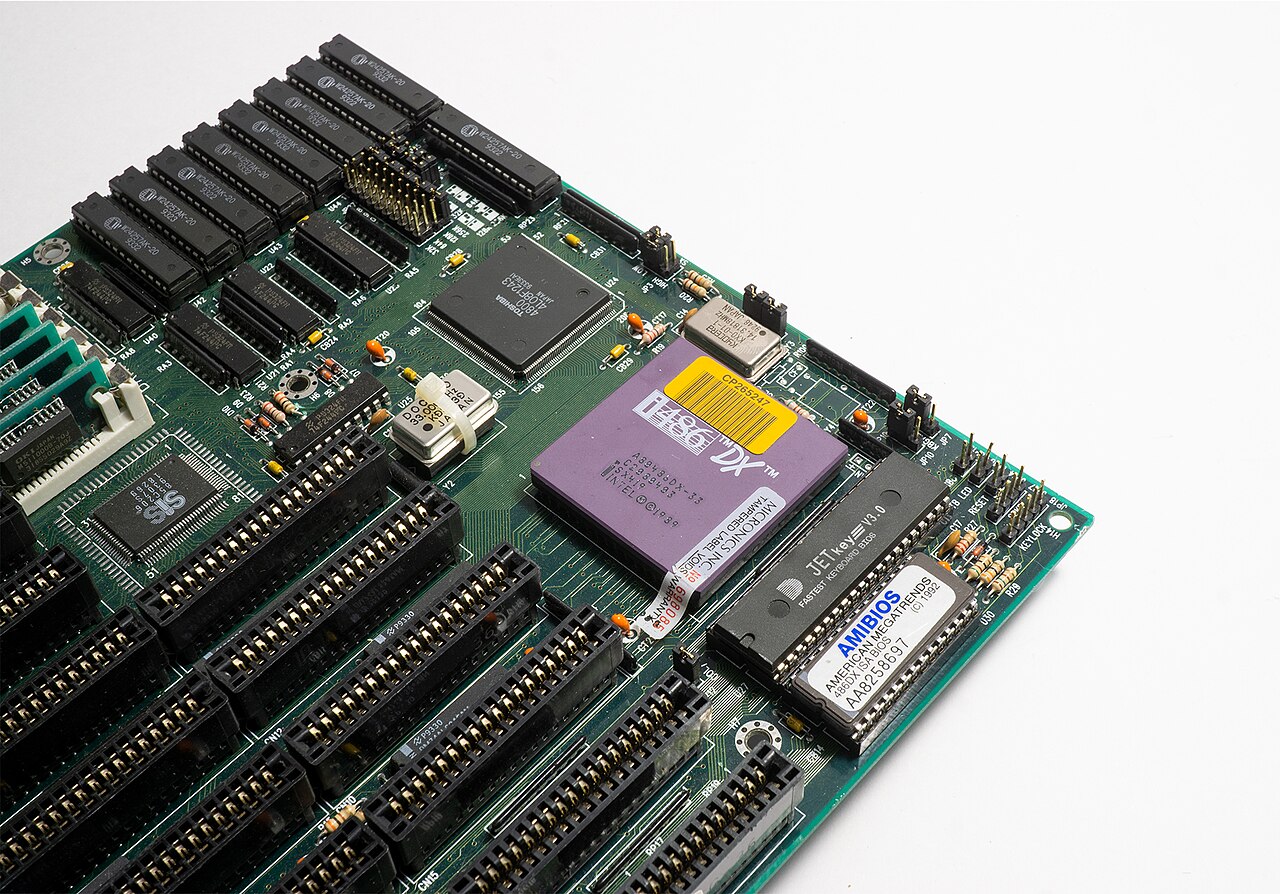
Hackaday's Tyler August reports that Domburg was tired of thinking of a motherboard as "deep magic", and that he picked the 486 because Intel let people at the documentation in those days. Domburg's own write-up says the 486 user manual is freely available and very informative. The prototype used an Intel 486-DX4-100, which the write-up calls the last 486 processor Intel made. A second board used an AMD 486-DX5-133, which he calls likely the last standalone 486 chip produced. Both chips run at 3.3 V, unlike the earlier parts that needed 5 V, which he notes is useful because 3.3 V is far more common today.
The board is a single-board computer with no ISA or PCI slots, a choice Domburg calls conscious. If he wants support for a device, he can re-implement it in the FPGA or emulate it on the ESP32-S3. The CPU itself is not emulated.
The silicon, part by part
All of the following comes from Domburg's write-up:
- CPU: Intel 486-DX4-100 (prototype) or AMD 486-DX5-133 (second board), both 3.3 V. The 486 he chose has 16K of internal cache.
- FPGA: Lattice ECP5 LFE5-45UM, 45k LUTs. He chose it because it has a good open-source toolchain and comes in a BGA package he can still hand-solder.
- Main memory: a 64 MiB SDRAM chip (16-bit, 100 MHz) behind a RAM controller in the FPGA.
- Video: Chips&Technologies F65545, a mid-range laptop chip from around the same era as the CPU. It has a 32-bit interface that connects directly to the CPU and needs 1 MiB of external DRAM. He bought the chips new-old-stock on Taobao.
- Microcontroller: ESP32-S3, linked to the FPGA over quad-SPI. The Codeberg README specifies an ESP32-S3-WROOM-N16R2 module.
- Other hardware: a USB hub, an I2S audio codec connected to the FPGA, a micro-SD slot, and USB-C for power and debugging.
Memory: where the compromise is
The 486 bus runs at 33 MHz and the SDRAM at 100 MHz, so one 486 bus cycle equals three SDRAM cycles. The SDRAM is 16-bit while the bus is 32-bit, so each bus access needs two SDRAM accesses. According to the write-up, an entire DRAM cycle completes in six 486 bus cycles, which he describes as "a paltry 16MByte per second", less than half of what an average contemporary 486 could do. He argues the CPU's 16K internal cache compensates for a large amount of that slowness in games, and says the controller could be optimised later with burst reads and better row handling.
He also reports DOS benchmark results from the prototype: Superscape 3DBench 1.0c gives about 35.7 FPS, Doom on max details about 21 FPS, and a Quake timedemo about 8 FPS. Norton System Information rates the board slower than a 486DX-33, which he attributes to the slow memory bus.
FPGA as chipset, ESP32-S3 as the expansion cards
Domburg did not write all the legacy PC logic from scratch. The PIC, PIT, DMA and Sound Blaster Verilog were copied from the ao486_MiSTer project, and the BIOS is a lightly modified variant of the one used in ao486. The FPGA and the ESP32-S3 work together to provide:
- an IDE controller with a hard disk and a CD-ROM drive
- an NE2000 network card that connects to a WiFi network
- a MIDI synthesiser implemented on the ESP32-S3
- a PS/2 controller and joystick ports, fed by USB- or BLE-connected keyboards, mice and gamepads
He chose the ESP32-S3 mainly for its internal USB-OTG peripheral, which handles mice and keyboards, and it can also talk to BLE devices such as an Xbox One gamepad. The write-up notes that the chip does not support classic Bluetooth.
There is also a debug feature borrowed from PC repair: a bus-snooping peripheral in the FPGA sends writes to IO port 80 to the ESP32 by default, and can forward other ports or port ranges too. Domburg calls this invaluable for debugging when a program does not play nice with the FPGA hardware. The ESP32 can also read and write main memory, which is how the BIOS and video BIOS are loaded into SDRAM before the CPU starts, so no separate ROM is needed.
The handheld parts
The handheld needed changes to the prototype. Domburg describes a 5.7-inch 640x480 IPS LCD with a parallel interface that connects directly to the F65545's LCD output, and a pair of 21700 Li-ion cells that he quotes at 4800 mAh. A separate power-management board carries an STC3115 gas gauge and an SGM41511 charger. The case is designed in OpenSCAD and the final one was resin-printed by an outside company. He runs MS-DOS 6.22 on it, and says the battery life is "pretty good, a few hours at least". He also says the system draws roughly 8 W, so it needs sizeable batteries.
What's in the repository
The Codeberg repository is described as "486 mainboard and handheld files". When we checked it had 140 commits on a single branch. By language it is 65% C, 30.4% Verilog and 1.5% OpenSCAD. It contains these folders:
case: the enclosureesp32andfpga: firmware and gatewarelcdbtn-pcbandpmu-pcb: the display/button board and the power-management boardmobo: the old prototype PCBmobo-portable: the mainboard used in the actual VapourDeck, which the README recommendssysbios: the system BIOS
The README says mobo-portable can run entirely standalone, without the LCD, battery and buttons, given a video BIOS that defaults to VGA output, and that the button and PMU boards are not needed in that case. That makes the mainboard usable as a small 486 desktop board as well as a handheld. Work is still going on: the write-up warns that some items may still be a work in progress, and the latest commit we saw is dated 26 August 2026 and is titled "Cd audio step 1: Add cd-audio in on fpga, add cue support to cd image".
What is not specified
The write-up gives no measured battery runtime beyond "a few hours at least", and the sources give no price. A Hackaday commenter asked about battery-life figures, and we have not estimated a runtime from the roughly 8 W draw.
What It Means for Makers
VapourDeck is not a product. It has no price, no kit and no pre-order. It is a personal build released as open source, Domburg says he does not expect anyone to produce it commercially, and according to Hackaday he is unsure anyone will want to replicate it. Anyone who does will need to hand-solder a BGA FPGA and track down new-old-stock F65545 graphics chips and a 3.3 V 486. Those are real obstacles for a hobby build, and the write-up warns the repository's open issues may affect builders.
The bigger value is as a reference design. If you have wondered what a PC chipset actually does, this repository answers it in Verilog and C. It shows an SDRAM controller bridging a 32-bit 486 bus to a 16-bit memory, legacy PIC/PIT/DMA blocks taken from ao486_MiSTer, and a modern microcontroller standing in for an IDE drive, an NE2000 card and a MIDI synth. For FPGA learners it is a worked example of tying a real vintage CPU bus to modern memory. For retro-PC builders who want real 486 hardware instead of emulation, the standalone mobo-portable route with VGA output may be the more practical part. Educators get a complete, documented x86 system small enough to teach from.
Status: open-source hardware, firmware and gateware, published and still being developed. Not for sale.
