
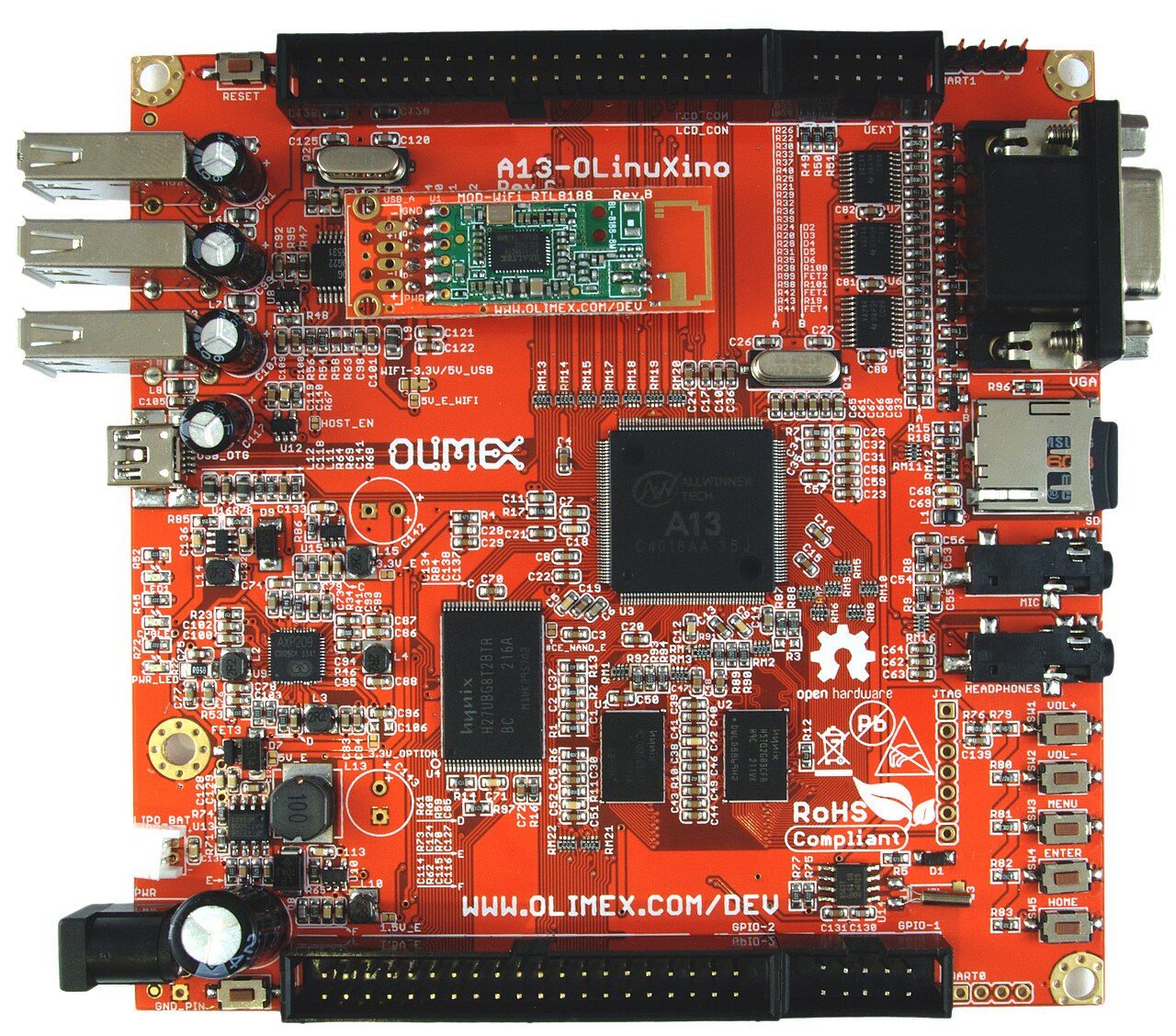
Espressif's ESP32-P4 is an unusual part in the ESP32 family because it has no radio at all. It is built as an application processor with HDMI-class video, USB host and Ethernet, not as a Wi-Fi endpoint. Olimex made it the basis of a small computer board, the ESP32-P4-PC. A developer who goes by jthwho has now given that board an operating system to match. BMDS, short for "Bare Metal Do Stuff", describes itself as a DOS-like OS for the Olimex ESP32-P4-PC. It packs a windowing GUI, a Bourne-style shell, a scripting IDE, Doom, networking and a package manager onto a microcontroller-class chip.
Hackaday covered the project on November 12, 2026. It called the design a one-user, minimally intrusive DOS-like model with a late-1990s style graphical interface. That is a good summary of the approach. BMDS does not try to be a small Linux. It is one machine for one person, and it stays out of the way of the programs it runs.
What is actually under the hood
BMDS is not written from scratch at the lowest level. Hackaday reports that it uses FreeRTOS as its kernel. The project README says it is built on ESP-IDF v6.1, Espressif's own development framework. The OS layer on top of that is what makes it feel like a desktop. According to Hackaday it loads and runs ELF binaries, offers some POSIX compliance and includes a port of BusyBox. Familiar command-line tools are therefore available from the shell, not just a handful of custom commands.
The project describes the following user-facing pieces:
- A windowing GUI in a late-1990s visual style
- A Bourne-style shell with BusyBox utilities
- An AngelScript IDE for writing and running scripts on the device itself
- Doom, a media player and a MIDI synthesizer
- Ethernet networking with SSH and SFTP access
- A package manager that installs signed package updates
- Flashing from a browser (Chrome or Edge) through a web installer at jthwho.github.io/bmds, so no local toolchain is needed
The repository had 281 commits when this was written. That points to sustained work rather than a weekend demo, though the README itself calls BMDS "young".
The hardware, and a clock-speed discrepancy
BMDS targets exactly one board, so the board's specs are the platform's specs. They should be stated carefully, because the two primary sources disagree on one number.
The BMDS README describes the hardware as two RISC-V cores at 360 MHz, 768 KB of internal RAM, 32 MB of PSRAM, 16 MB of flash, HDMI output, four USB-A ports, 100 Mbit Ethernet, microSD and an audio codec.
Olimex's product page lists the board's ESP32-P4NRW32 module as a dual-core 400MHz RISC-V part with 768KB RAM, 32MB PSRAM and 16MB external SPI flash. Its interface list is Ethernet 10/100 with a PoE option, MIPI CSI and DSI, HDMI, an audio jack, a LiPo charger, microSD and a UEXT connector. Olimex states plainly that the ESP32-P4 has no Wi-Fi or Bluetooth.
Memory, flash and the main interfaces agree between the two sources. The clock does not: the README says 360 MHz and the vendor says 400MHz. Neither source explains the gap. A plausible reading is that the README reflects the speed actually reached on the author's early chip revision. That is our inference, not something either source states. For buying decisions, treat Olimex's 400MHz as the vendor specification and the README's 360 MHz as what BMDS documents for its own target.
The limits are real, and the author lists them
BMDS is open about what it does not do, and the list matters for anyone thinking of buying a board for it.
One board, early silicon. BMDS supports only the Olimex ESP32-P4-PC. The README says it runs on ESP32-P4 chip revisions before v3.0, and the author's own chips are v1.3. Boards with v3 silicon need a separate build that, according to the README, has not been tried yet. Check your board's chip revision before assuming it will work.
No radios. The ESP32-P4 has no Wi-Fi or Bluetooth, and BMDS says so. All networking goes over the wired Ethernet port. SSH and SFTP therefore need a cable to a switch or router.
No memory protection. The README states that programs share one address space. That is the DOS model in the literal sense. It keeps things simple and fast, but a faulty program can crash the machine, and nothing isolates untrusted code. That matters on a machine with SSH enabled and a package manager pulling code from the network. The README notes that releases are signed with a development key, so the signature proves a package is whole, not who made it. Signing addresses integrity, not runtime isolation.
Fixed display mode and keyboard layout. The project supports 1280x720 output only and a US keyboard layout only. Monitors that don't accept 720p and non-US typists will hit those walls immediately.
None of these limits is unusual for a hobby OS. Still, they define the audience: people who want this specific machine to be a self-contained computer, not people looking for a general-purpose ESP32 platform.
Why the ESP32-P4 makes this possible
An OS like this on an ESP32 would once have been a stunt. On the P4 it is a fair fit. 32 MB of PSRAM leaves room for a framebuffer, a windowing system and applications to live together. HDMI, USB host and Ethernet on one board mean the machine needs no other computer once it is flashed. Dropping the radio, which looks odd for an Espressif part, arguably suits a desktop design, since there is no Wi-Fi stack to maintain. That is our reading, not a claim from the sources.
Building on FreeRTOS and ESP-IDF instead of a bespoke kernel also makes sense. The README says BMDS provides everything above the kernel itself: the drivers, filesystems, window system and GUI toolkit, shell and program loader. The author's effort goes into the parts that make it an OS a person would use.
What It Means for Makers
BMDS is for a fairly specific group: retro-computing fans, people who like owning a computer they can understand from top to bottom, and educators who might want a single-board machine where students can write AngelScript, open a shell and see the whole system without Linux in between. It does not replace a Raspberry Pi running a full Linux distribution, and it does not claim to. What it offers is a complete, self-hosted computing environment on a microcontroller-class board. It also gives a concrete answer to the question many people asked when the ESP32-P4 appeared: what is a radio-less ESP32 for?
On price and availability, Olimex lists the ESP32-P4-PC at 24.95 EUR and showed it in stock on its product page in November 2026. BMDS is open source on GitHub (MIT license) and installs through its browser-based web installer. It is a working, released project, not an announcement. Before ordering a board for it, keep three caveats in mind: the pre-v3.0 chip revision requirement, the 1280x720 display mode and the US-only keyboard layout. And if clock speed matters to your plans, note that Olimex specifies 400MHz while the BMDS documentation says 360 MHz.
