
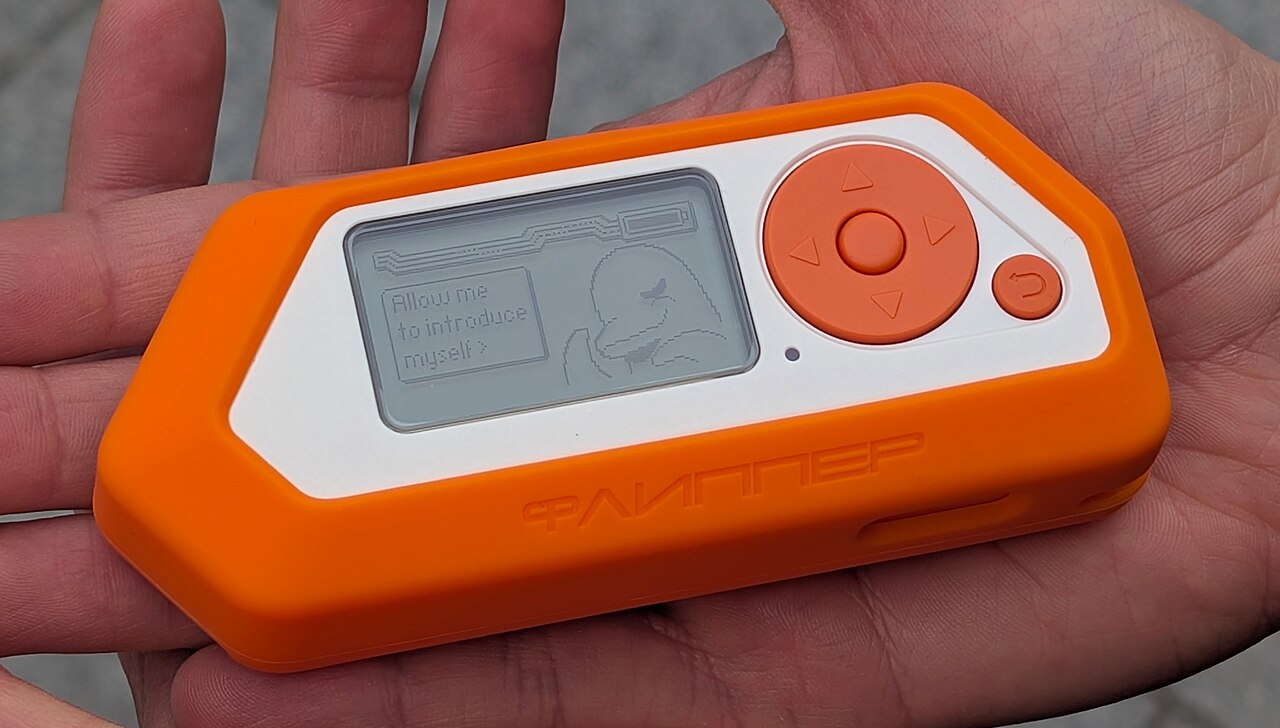
Flipper Devices has moved the Flipper One a step closer to crowdfunding. In a report published November 11, 2026, Hackster quotes the company: "We've passed Kickstarter verification for the Flipper One campaign." The company is now selling $20 pre-order coupons, which Hackster describes as a refundable-until-used deposit. According to Hackster, a coupon unlocks a "hidden reward tier" that lets the holder buy the device for $379 at launch. Coupon holders will get an email with launch dates. Shipping at launch is listed for the USA, EU, UK, Canada and Australia.
Be clear about what stage this is. Hackster says the Kickstarter page exists but is not yet open for backing, and notes that as with any crowdfunding campaign, fulfillment is not guaranteed. We found no delivery date in the sources we read. Flipper's own product page currently shows a "PRE-ORDER NOW" button. In the page text PinoutFeed extracted on November 13, it did not state the $379 price or a campaign date. We could not check the reward tier against the Kickstarter page itself. The $20 deposit, the $379 price and the Kickstarter verification therefore rest on Flipper's statement as Hackster reported it. Treat the figures as provisional until the campaign opens.
Not a Flipper Zero 2
The Register made this point when the device was unveiled in May: the Flipper One is not a successor to the Flipper Zero. It is a full Linux computer in a handheld case. Flipper's product page calls it an "Open Linux Multi-tool based on a powerful ARM processor," a "network toolkit with built-in Wi-Fi 6E and Gigabit Ethernet," that is "expandable via M.2 modules: 5G cellular modem, SDR radio and more."
The Zero was a microcontroller gadget. The One is an application-class Arm system with a microcontroller beside it. That split is the most interesting engineering decision in the design.
Two processors, two jobs
Flipper's official flipperone-mcu-firmware repository on GitHub sets out the architecture. The main processor is a Rockchip RK3576, which runs Linux. USB, HDMI, M.2, Wi-Fi, Ethernet and audio all connect to it. The low-power co-processor is a Raspberry Pi RP2350, which connects to the buttons, LCD, touchpad and LEDs and manages the battery and power control.
The README says the main CPU sends display data to the MCU over SPI. The two chips are linked by SPI, I2C and UART, plus GPIO lines for BOOT_0, BOOT_1 and IRQ. When the device is off, the MCU handles power-bank mode and power states, and it also takes part in booting the main CPU. Flipper's product page describes the same split. The RP2350 handles the LCD, buttons, status LEDs, the power sub-system and the Linux boot parameters while Linux is off, and the RK3576 runs Linux.
In practice, the front-panel UI, power management and boot control sit on a chip that stays awake when the Linux side is shut down. The README notes that documentation for the co-processor architecture is still to come. Hackster and The Register name the part as the RP2350B, the higher-pin-count package of the RP2350.
The spec sheet, as published in May
The fullest spec list comes from Flipper's May 2026 reveal, as CNX Software reported it on May 21. Unless noted, the figures below are from that list.
- SoC: Rockchip RK3576 with 4x Cortex-A72 @ 2.2GHz and 4x Cortex-A53 @ 1.8GHz, an Arm Cortex-M0 MCU at 400MHz, a Mali-G52 MC3 GPU and an NPU rated at 6 TOPS INT8. (Hackster's article lists the little cores as "Cortex-A54". This is an error, and we use CNX's Cortex-A53.)
- Memory: 8GB LPDDR5.
- Storage: 64GB UFS 2.2 plus a microSD slot (UHS-I).
- Co-processor: RP2350 @ 150MHz with 264KB SRAM and 16MB flash, driving a 256 x 144, 64-level grayscale display.
- Video out: HDMI 2.1 up to 4Kp120, and DisplayPort 1.4 over USB-C.
- Wired networking: two Gigabit Ethernet ports (RTL8211F-CG PHYs).
- Wireless: tri-band Wi-Fi 6 with 2x2 MIMO and Bluetooth 5.2 through an MT7921AUN module.
- Cellular: optional 4G/5G modem on M.2, with a nano SIM slot.
- USB: one USB 3.1 Type-A port and two Type-C ports.
- Expansion: M.2 Key-B carrying PCIe 2.1 x1, USB 2.0/3.1 and SATA3, plus a 20-pin GPIO header.
- Power: USB PD input from 5V to 20V and a 7,000 mAh battery. CNX notes that the battery capacity for mass production is not final.
- Dimensions: 155 x 67 x 40 mm.
One discrepancy is unresolved. Flipper's current product page says "Wi-Fi 6E". The May spec list on CNX says tri-band Wi-Fi 6 via the MT7921AUN module. Until Flipper publishes a final datasheet, check this line again before relying on 6GHz operation. Remember too that the whole list dates from May, and that items such as the battery were explicitly marked as subject to change.
The mainline-kernel bet
The software plan may matter more than the specs. Flipper's product page says the goal is a mainline Linux kernel with no binary blobs and no vendor BSP. Collabora announced on May 21 that Flipper chose it as its open source software partner for RK3576 upstreaming. Collabora describes the goal as a long-lived, open Linux platform that does not depend on a vendor BSP.
This is where many Rockchip boards fall down. They ship on a frozen vendor kernel that stops getting updates long before the hardware wears out. If the RK3576 work lands upstream, the benefit reaches every RK3576 board, not just Flipper's. CNX notes that upstreaming is still in progress and that some claims may be hard to meet: the bootloader usually needs a closed-source blob for RAM initialization, and Wi-Fi and cellular firmware is usually closed.
What It Means for Makers
Who it is for. The Flipper One targets people who now carry a laptop, a USB Ethernet dongle or two, and an SBC in a project box to do network work in the field. Two Gigabit ports on a handheld make inline captures and bridge or router experiments possible without extra adapters. The M.2 Key-B slot lets the same unit take a cellular modem or, as Flipper's page puts it, an SDR radio. The 20-pin GPIO header and the RP2350 side give embedded developers a hardware hook that a phone or laptop lacks.
What it replaces or enables. It overlaps with an RK3576-class SBC plus battery, case and screen, and with a small travel router, in one enclosure that has its own UI processor. It is not a Flipper Zero replacement. The Register notes there is no NFC or RFID reader onboard, and we found no Sub-GHz or infrared hardware listed in the sources. Anyone buying it for Zero-style radio tricks should wait for the final module list.
Price and availability, as the sources state them. Hackster reports the following as of November 11, 2026:
- A $20 coupon is on sale now as a pre-order deposit.
- The coupon reserves the device at $379 when the Kickstarter campaign launches.
- Launch shipping covers the USA, EU, UK, Canada and Australia.
- The campaign page is not yet open for backing.
- The $20 deposit is described as refundable until used.
Flipper's own page offers pre-orders but did not state the price in the text we read. For anyone deciding whether $20 is worth it: the hardware list is a spring snapshot with an unfinished battery spec and an unsettled Wi-Fi spec. The mainline-kernel plan depends on upstream work that is still in progress.
Sources
- Flipper One - Open Linux Multi-Tool (Flipper Devices product page)
- Hackster News: Flipper Devices Readies Crowdfunding for the Flipper One, Opens Pre-Orders for a $20 Deposit (Nov 11, 2026)
- CNX Software: Flipper One - A Rockchip RK3576-powered portable Arm Linux computer and networking multi-tool (May 21, 2026)
- Collabora: Collabora + Flipper: Opening up the RK3576 (May 21, 2026)
- The Register: Flipper One wants to be the Linux multi-tool in your pocket (May 21, 2026)
- flipperdevices/flipperone-mcu-firmware (GitHub)
