
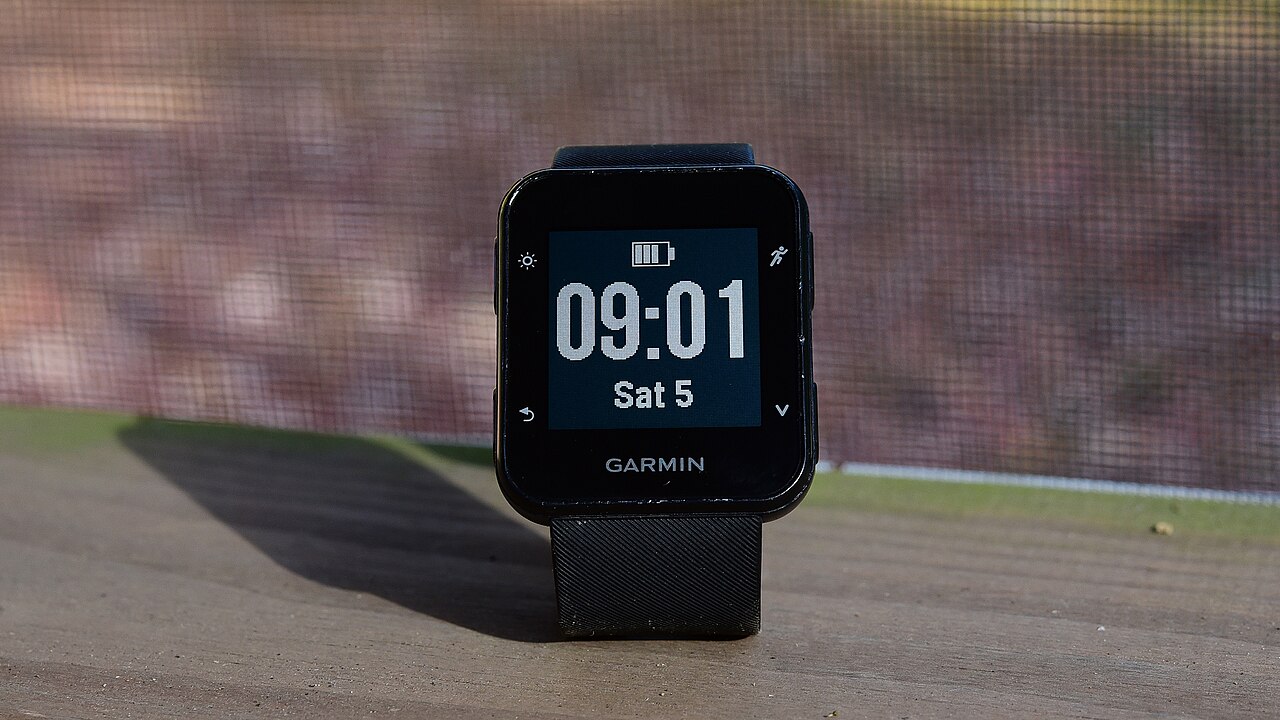
Most smartwatches are locked down. Writing your own app usually means a vendor's scripting runtime, an approval process, or both, and opening the case usually voids the warranty. The UNA Watch takes the opposite approach. Your app is a compiled Arm binary that runs directly on the microcontroller. The hardware design files are on GitHub. The battery and display are replaceable parts. After a Kickstarter campaign in April 2025, according to LinuxGizmos, the watch now has a listing at Pimoroni, where it is offered as a pre-order.
Below we cover what the hardware is, how the software model works, and the trade-offs that come with a microcontroller-class wearable that lets you write directly to the metal.
The hardware, as listed
Pimoroni's product page (SKU UNA-WCH01-CH) gives the core platform as a Cortex-M33 with 2.5MB of RAM and 4GB of storage. LinuxGizmos names the part as an STM32U595 and says the 4GB is eMMC. Pimoroni's listing does not give a clock speed and neither does any other source we checked, so we don't quote one here.
Here is the rest of the spec sheet as Pimoroni lists it:
- Display: 1.2in 240x240 MIP (memory-in-pixel) LCD with LED backlight, replaceable
- Positioning: GPS. LinuxGizmos adds that GNSS support covers GPS, GLONASS, Galileo, BeiDou, NavIC and QZSS.
- Wireless: Bluetooth LE 5.2
- Sensors: heart-rate monitoring (LinuxGizmos specifies optical HR), accelerometer, gyroscope, magnetometer and barometric altimeter. LinuxGizmos also lists temperature sensing.
- Output: haptic motor and piezo sounder
- Power: replaceable hard-shell battery and USB-C charging. UNA quotes up to 10 days of everyday use or 20 hours of GPS tracking. Pimoroni presents these as UNA's figures, and we have not tested them.
- Ingress: IPX5. Pimoroni notes it is not for swimming.
The box contains the watch, a silicone strap, a 0.5m USB-C cable and a quick start guide. Pimoroni points out that the T3 Torx tool used for repairs is not included.
The MIP panel suits the watch's purpose. Memory-in-pixel LCDs hold their image with very little power and stay readable in direct sun. That is why sports and outdoor watches tend to use them instead of OLED. The 240x240 resolution is small, but a GUI running on a microcontroller doesn't have to push many pixels.
How apps actually run
The software model is where UNA differs most from mainstream wearables. According to the maker's SDK platform overview, apps are compiled Arm Cortex-M ELF binaries that execute directly in MCU memory. LinuxGizmos says the system runs on FreeRTOS. Apps are built as position-independent code, so the kernel can load them at any address. They also share a common libc, so each binary doesn't carry its own copy.
The documentation describes a dual-process design. Every app has a service process for background logic, sensors and BLE, and a GUI process for the interface. That split matters for a sports watch, where a GPS logger or heart-rate recorder has to keep running while the screen shows something else.
Pimoroni summarises the workflow simply. The public C++ SDK comes with reference apps and a desktop simulator. You build with CMake and copy the resulting .uapp file to the watch over USB. The simulator should matter more than it sounds. Iterating on UI code on a desktop and only flashing to the wrist once things work is much faster than a flash-and-squint loop on a 1.2-inch screen.
The catch: no MMU
The maker's documentation is upfront about the cost of running native code on a microcontroller. The platform overview says there is no MMU, so an app can read the entire MCU memory. It also says developers need to ensure their apps do not interfere with each other or with the kernel.
That is the expected situation on a Cortex-M part, not a hidden flaw. But it means the trust model is closer to a bare-metal dev board than to a phone. If you sideload a binary from a stranger, it can read everything in the MCU's memory. A buggy app can also interfere with other apps or the kernel. Firmware engineers will find this familiar. People who are used to app-store sandboxing should treat third-party .uapp files the way they would treat an unknown firmware image.
Open hardware, in practice
Pimoroni says the housing and PCB designs are released under CC BY 4.0 and that the kernel firmware is published. LinuxGizmos reports public GitHub repositories for the SDK, the firmware and the hardware designs, and says the SDK itself is under the MIT license.
The UNAWatch/una-hardware repository explains what "open hardware" covers here. According to its README, the aim is to let users debug their own hardware. For each of the six PCBs in the watch it provides schematic, assembly and fabrication drawings, plus .stp files for each mechanical part. The README also states that the designs are licensed under CC BY 4.0, matching Pimoroni's description.
Six boards in a watch-sized enclosure fits the modular, repairable pitch. Swapping a part becomes plausible when the subassemblies are split up and documented. The README frames the files around debugging your own hardware, not around building your own watch from scratch. Still, CC BY 4.0 is a permissive licence: the README says you are free to use, reproduce, modify, manufacture from and redistribute the materials with appropriate attribution.
The phone side
According to Pimoroni, a free iOS and Android companion app syncs activity data to Strava and needs no subscription. LinuxGizmos also mentions the Strava integration. For a sports watch, Strava sync is the minimum most buyers will expect, and the absence of subscription fees is a notable contrast with fitness platforms that charge for analytics.
What It Means for Makers
UNA is aimed at a specific group: embedded developers and makers who want a wearable they can program like a microcontroller board, plus runners and hikers who care about repairability. Many hackable watches are dev-kit-style wrist boards, while mainstream GPS watches typically keep their software closed. UNA tries to sit between them. It has multi-sensor sports hardware (a barometric altimeter, a magnetometer and multi-constellation GNSS according to LinuxGizmos), a public C++ toolchain, and published design files for when something breaks.
Educators may also find it useful. A desktop simulator, CMake builds and FreeRTOS underneath could make a reasonable teaching platform for real-time embedded work on a device students will actually wear. The lack of an MMU, which the maker documents, can be part of the lesson.
Price and availability: Pimoroni lists the UNA Watch (Charcoal) as a pre-order at US$201.00 on its en-us store, checked in November 2026. LinuxGizmos also reports $201 for the Charcoal model, with White and Teal options shown. Confirm the final price at checkout. Pimoroni does not give a shipping date for pre-orders in the material we reviewed. The watch first appeared on Kickstarter in April 2025, according to LinuxGizmos. Budget for a T3 Torx driver if you plan to use the repairability, because one is not in the box.
