
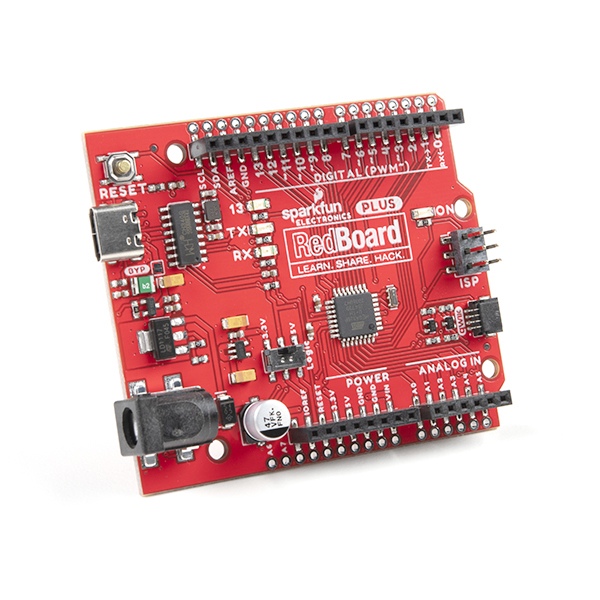
SparkFun has introduced a pair of development boards built around Espressif's ESP32-P4 in the Arduino UNO R3 footprint. Both are sold as the IoT RedBoard ESP32-P4, and they differ in how they connect to a network. The IoT RedBoard ESP32-P4 and ESP32-C5 (WiFi/BLE) pairs the P4 with an ESP32-C5 WROOM module for wireless. The RedBoard ESP32-P4 (PoE) drops the radio module and adds wired 10/100 Ethernet with Power over Ethernet. That is how SparkFun's own hookup guide describes the two versions.
Both boards use the v3.x silicon revision of the P4. CNX Software identifies the SoC as the ESP32-P4NRW32X v3.x and also refers to it as the ESP32-P4X. Putting this part on a familiar UNO-shaped board, with a schematic and layout you can open, seems to be the point of the release.
The common platform
SparkFun's hookup guide lists the ESP32-P4 as a dual-core RISC-V processor running at up to 400 MHz, with a separate low-power (LP) core at up to 40 MHz. CNX Software gives the memory configuration as follows:
- 768 KB HP L2MEM
- 32 KB LP SRAM
- 8 KB LP TCM
- 32 MB PSRAM
- 16 MB SPI NOR flash, plus a microSD slot
The 32 MB of PSRAM is the figure that matters most for the camera and display work the board is designed for. Both versions carry two MIPI ribbon connectors, which the SparkFun GitHub repository describes as being for cameras and displays. CNX Software lists them as 2-lane MIPI DSI and 2-lane MIPI CSI, on 22-pin 0.5 mm FPC connectors. That is a strong video interface for a board that takes UNO-style shields.
On the headers, the repository says the boards break out the RedBoard/R3 pinout: analog, digital I/O, I2C, SPI and UART. CNX Software counts 16 digital I/O and 6 analog I/O, plus a Qwiic connector for SparkFun's I2C ecosystem.
For USB, CNX Software lists two USB-C ports. The GitHub repository describes the USB-C functions as Serial/JTAG and 480 Mbps USB 2.0 OTG, which gives you a debug and programming path and a separate high-speed USB port that can act as host or device.
The power options are broader than on most UNO-format boards. CNX Software lists a 7–15 V DC barrel jack, and the repository notes a 2-pin JST connector for a single-cell LiPo. According to CNX, an MCP73831 charger and a MAX17048 fuel gauge are on board, so firmware can read the battery's state of charge without extra parts. CNX gives the board dimensions as 68.6 x 58.4 mm.
Software support covers the usual Espressif options. The repository says the boards ship pre-programmed with MicroPython and are supported in both ESP-IDF and the Arduino IDE, with one caveat covered below.
Version one: ESP32-C5 for wireless
The WiFi/BLE version gets its wireless from an ESP32-C5 WROOM module. SparkFun's hookup guide lists dual-band 2.4/5 GHz Wi-Fi, Bluetooth 5 (LE), Zigbee and Thread. CNX Software describes the Wi-Fi as Wi-Fi 6. CNX lists the Zigbee and Thread support as IEEE 802.15.4, which means this board can sit on a Thread or Zigbee network as well as an ordinary Wi-Fi LAN. That is useful if you are building a camera-equipped node or a touchscreen controller for a smart-home system.
The catch is software. CNX Software reports, citing SparkFun, that Arduino-ESP32 core v3.3.12 does not natively support the ESP32-C5 wireless interface. SparkFun supplies a patch for the Espressif Arduino core, and the GitHub repository keeps those patch files in its /Arduino directory. In practice, Arduino users of the wireless version will need to apply the patch until upstream support arrives. Neither source says when that will be.
Version two: wired Ethernet and PoE
The PoE version replaces the radio with a wired connection. SparkFun's guide describes a MagJack, a 10/100 Mbps Ethernet transceiver and a buck regulator that lets the board run on power from the Ethernet cable. CNX Software gives the part numbers: a TI DP83825 PHY and a Silvertel Ag9905M 802.3af PoE module, which takes 36–57 V PoE input and supplies 5 V at 1.8 A to the board.
The PoE board has the easier software story. According to CNX Software, Arduino-ESP32 core v3.3.12 already supports the Ethernet version without a patch.
Open hardware files
SparkFun's repository includes the KiCad design files (.brd and .sch) in its /Hardware directory, alongside the Arduino patches and the hookup guide. For anyone planning a custom P4 carrier board, a working reference layout for MIPI, USB 2.0 high-speed, PoE and P4-to-C5 wiring is arguably worth as much as the boards.
What It Means for Makers
These boards are for people who want the ESP32-P4's camera, display and USB features in a format that accepts UNO R3 shields and Qwiic sensors, without designing a board around a high-pin-count SoC. The wireless version suits battery-powered or untethered vision and HMI projects that also need to join a Thread or Zigbee network. The PoE version suits fixed installations, such as a camera at a door, a wall-mounted status display or a networked sensor hub, where one Ethernet cable carries both data and power.
The boards are not the only ESP32-P4 option. CNX Software names the Wireless Tag WTDKP4C5-S1 and the Waveshare ESP32-P4-WIFI6-POE-ETH as competitors, and notes that none of the competing boards follow the Arduino form factor. SparkFun's case rests on the UNO R3 footprint, Qwiic, the on-board LiPo charging and fuel gauging, MicroPython out of the box, and published KiCad sources.
Price and availability: CNX Software reports that the boards are sold through the SparkFun store at $49.95 (USD) for the ESP32-C5 WiFi/BLE model and $55.95 for the PoE variant, as of its November 9, 2026 article. The SparkFun pages we read did not list prices, and the repository lists the part numbers as DEV-30909 (WiFi/BLE) and DEV-30910 (PoE). Documentation, schematics and KiCad files are already on GitHub. Arduino users choosing between the two should note the software split: the PoE version works with the stock Arduino-ESP32 v3.3.12 core, while the Wi-Fi/BLE version currently needs SparkFun's core patch.
