
Most microcontroller "operating systems" with a graphical front end work like a bootloader menu: pick a program, and the UI disappears while it runs. Sylphide OS, an open project from Thomas Capricelli of freehackers.org, wants the desktop to stay. Version 0.1 runs a windowed GUI with a desktop, menu, window manager and icons on top of a FreeRTOS kernel, and its flagship hardware is Olimex's ESP32-P4-PC, which the maker lists at EUR 24.95 and in stock as of 29 October 2026.
Hackaday's Jenny List wrote up the project on 29 October 2026, and it reached Hacker News the same day. Both audiences asked the same thing: at this stage, is it an operating system or a FreeRTOS distribution with a nice shell?
What Sylphide Is Trying to Be
The project page calls Sylphide a general-purpose OS for MCU-based computers, and it says exactly what "computer" means here: a keyboard and mouse, a VGA or HDMI display driven from a real framebuffer, storage, and optionally a network. The hardware side is open too. PCBs are designed in KiCad, and the source lives in a Mercurial repository at freehackers.org rather than on GitHub.
The code is mostly C for the drivers and rendering, with "limited" C++ for the GUI layer, on top of FreeRTOS. The author lists these pieces as done in 0.1:
- kconfig-based build configuration
- framebuffer handling, bitmaps and fonts
- three hardware targets with their drivers
- a GUI with desktop, menu, windows, a window manager and icons
These are listed as planned, not shipped: microSD and USB storage, Ethernet and Wi-Fi networking, a widget set, and loading external programs. That last item matters. Until the OS can load and run software it was not compiled with, it is a demonstration of a desktop and not yet a platform for one.
Hackaday's write-up says the GUI "appears to owe a lot to the early Macintosh machines" and that it also drives a screen through a framebuffer with keyboard and storage interfaces. List also draws the distinction that sets Sylphide apart from the usual MCU launcher: it is meant to persist underneath running programs.
The Targets
The project names four:
- Olimex ESP32-P4-PC, the flagship target
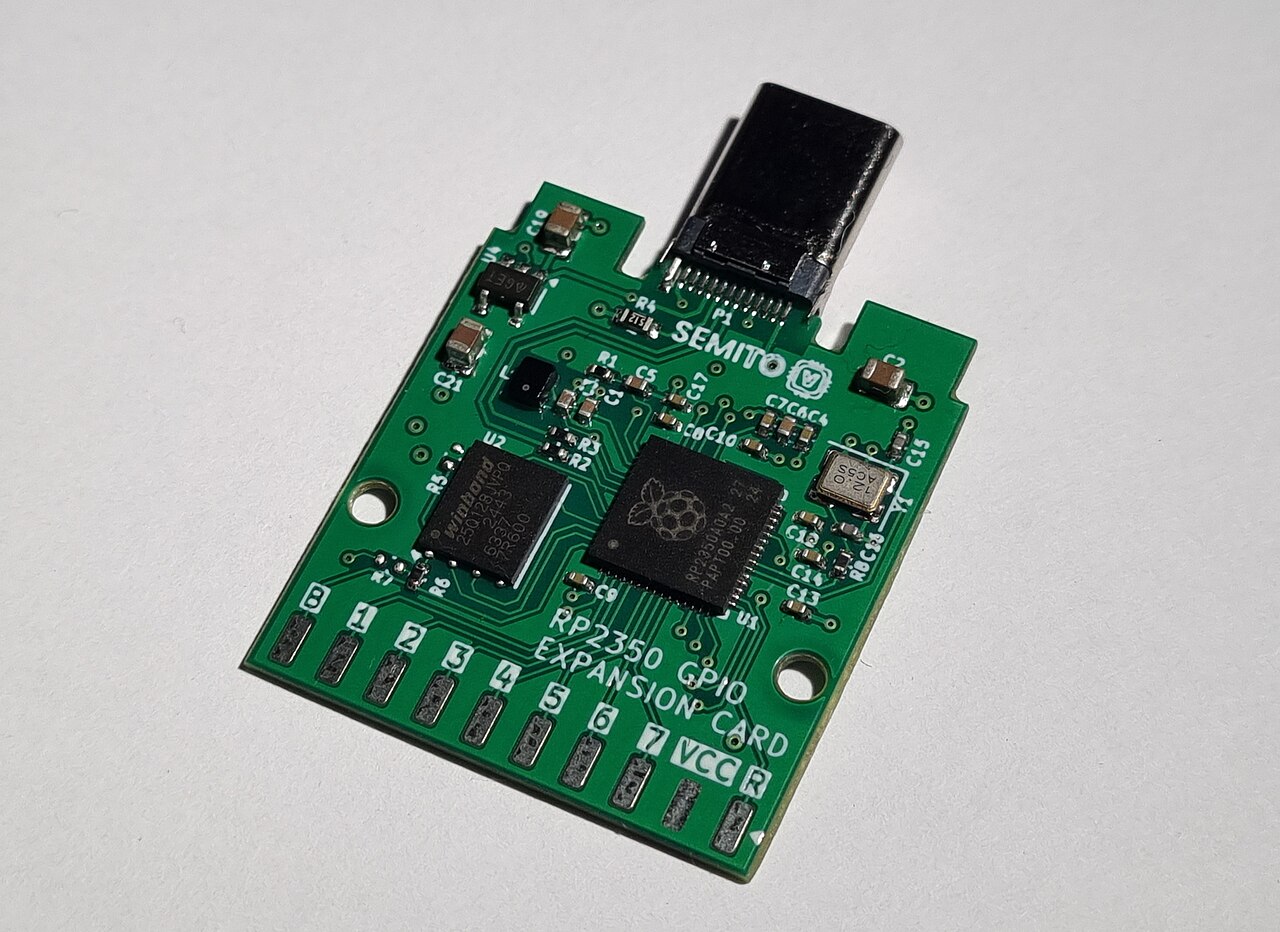
- Raspberry Pi Pico 2, using the author's own minimalist VGA-plus-USB design built around the RP2350
- FabGL
- A Linux emulator, for development without hardware
The project materials we reviewed give no resolution or performance figures for the RP2350 VGA design, so we won't guess at any. The ESP32-P4-PC target has its own detailed page, and it is the one to look at closely.
The Board: Olimex ESP32-P4-PC
According to Olimex's product page, the ESP32-P4-PC is a small ESP32-P4 computer with four USB hosts, Ethernet, HDMI and LCD output, a MIPI camera interface, an SD card slot, USB-C power, a PoE option, LiPo battery UPS and audio output. The listed specifications:
- Espressif ESP32-P4NRW32 module
- Dual-core 400 MHz RISC-V
- 768 KB RAM, 32 MB PSRAM, 16 MB external SPI flash
- USB JTAG
- Ethernet 10/100 MAC/PHY, with a PoE option via extension
- CSI camera and DSI LCD connectors, plus an HDMI converter
- 3.5 mm audio output
- LiPo charger
- microSD card slot
- Boot and reset buttons
- UEXT connector
- Free GPIOs on a 20-pin 2.54 mm connector
- Three mounting holes; 90 x 60 mm
Olimex states plainly that the ESP32-P4 chip has no Wi-Fi or Bluetooth. Anyone expecting a wireless ESP32 should note this before ordering. On this board, any networking would have to go over wired Ethernet. The hardware is open source: Olimex publishes schematics as a PDF, a KiCad repository and ESP-IDF demo code, and the board has Arduino IDE support from ESP32 package 3.1.x onward.
How the Display Works, and Its Limits
The ESP32-P4 has no native HDMI output. The board takes the chip's DSI output and converts it with an LT8912B DSI-to-HDMI bridge. Sylphide's target page explains what that means for a desktop OS.
The project says the hardware can do 1280x800 at 60 Hz and 1920x1080 at 30 Hz, both at 24 bits per pixel. The low end is ruled out: 640x480 and low colour depths are not possible, because the pixel clock bottoms out at around 50 MHz and the bridge accepts only 24-bit RGB. A classic 1-bit Mac framebuffer is therefore not an option on this board, even though the GUI borrows that look. Every frame is true colour, whether or not the desktop needs it.
Each pixel costs three bytes, so the framebuffer cannot fit in the 768 KB of on-chip RAM. The author reports that the PSRAM bus is fast enough to hold the framebuffer there. The mode currently running is HDMI 1280x720 at 60 Hz in true colour. Per the project page, the author could not validate the other modes the hardware supports: they either do not work at all or flicker badly.
The USB Hub Problem
The second limitation affects input. The ESP32-P4 supports USB Low, Full and High Speed, but the board routes its USB through an on-board four-port hub, and the Sylphide page describes a hardware limitation where Low Speed devices do not work through that hub. Many basic keyboards and mice are Low Speed devices. The author uses a workaround, and the current status says input is done over USB with that hack, but you can only use a keyboard or a mouse, not both, so far. On a desktop OS today, that means you can type or you can point, but not both in the same session.
OS or Distro?
The Hacker News thread had 34 points and 11 comments when we read it. The top comment criticised the name: it argued that calling it an OS is premature while the drivers for storage and network are still only planned. The submitter replied that building on FreeRTOS should make those fairly cheap to implement. That is a fair answer about effort, though it doesn't settle whether the label fits yet. Hackaday raised the same question more gently, noting you can argue about whether Sylphide is an OS in its own right or a FreeRTOS distro.
One comment shows the board has other takers. A commenter said they try on and off to port the Oberon System 3 to the same Olimex ESP32-P4-PC, which they received in February, and that the display already works well. HDMI, four USB ports, Ethernet and 32 MB of PSRAM at under EUR 25 look like a draw for people who want a microcontroller that behaves like a small personal computer.
What It Means for Makers
Sylphide 0.1 is aimed at people who like operating system internals: anyone curious how a window manager, framebuffer and input stack fit together on a microcontroller with 768 KB of on-chip RAM plus PSRAM, and who would rather read C than a Linux kernel. It is not yet a replacement for anything. It has no storage or network drivers yet, can't load external programs, and on the flagship board it can't take keyboard and mouse input at once. The author's page says all of this openly, which is to the project's credit.
What it does offer is a readable, open reference for a persistent GUI on MCU-class hardware, on open hardware you can buy today. Olimex lists the ESP32-P4-PC at EUR 24.95 and in stock as of 29 October 2026, with KiCad files and schematics published. If you don't want to buy the board, the Linux emulator target lets you look at the code first. The Pico 2 VGA design uses the author's own hardware and not an off-the-shelf board, so check the project page for its build details before treating it as a ready-made option. Sylphide itself is early-stage source code, version 0.1, in a Mercurial repository.
