
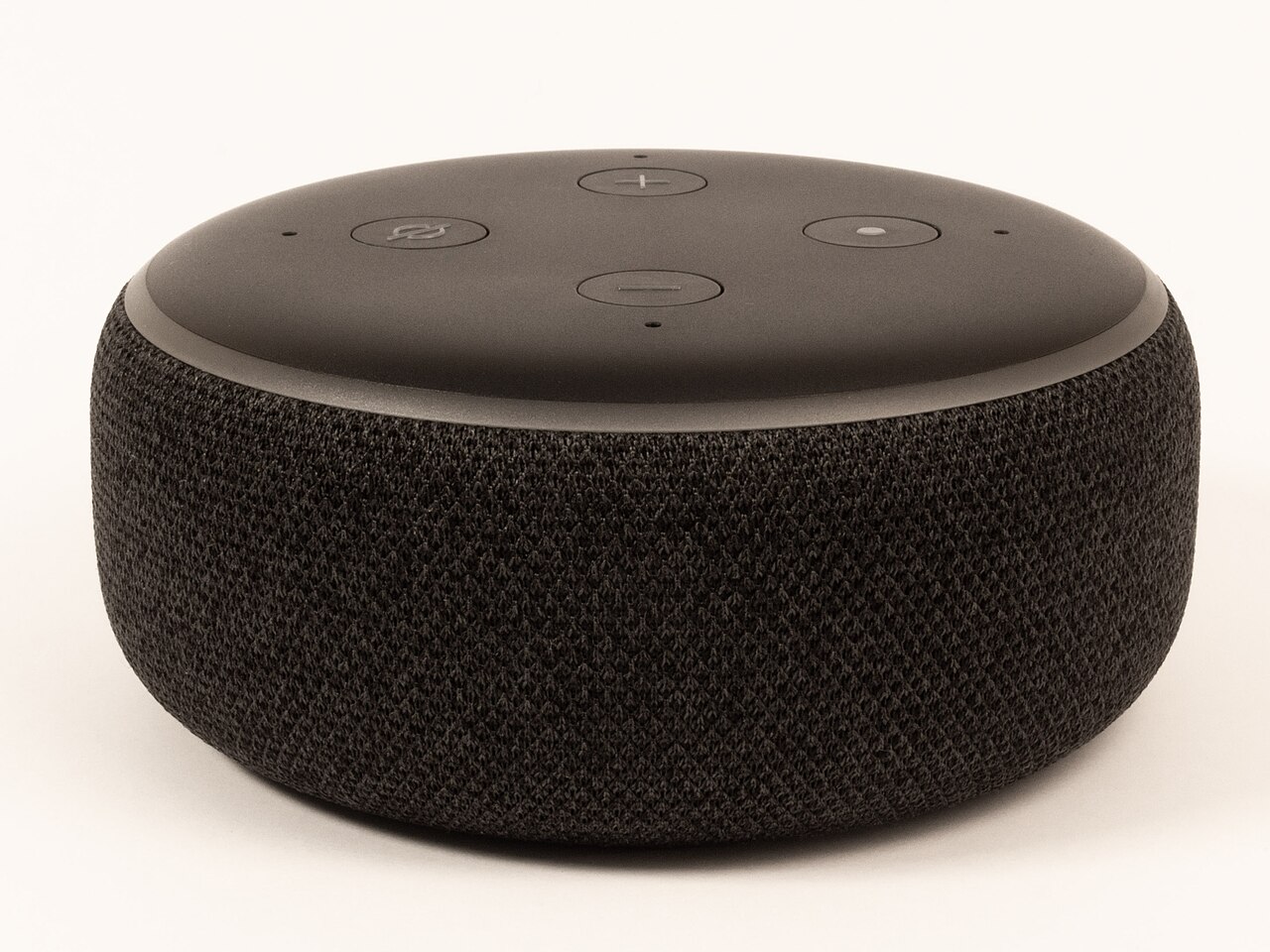
The third-generation Amazon Echo Dot packs a four-microphone array, a speaker, buttons and a ring of LEDs into a single enclosure. The weak point, for anyone who wants a voice assistant that answers to their own server and not a cloud service, is the board inside. LocalDot, a project from AAElectronics, replaces that board and leaves everything else where it is.
The project is open source, and its GitHub repository describes it as a replacement board for the 3rd-gen Echo Dot that keeps the original enclosure, four-mic array, speaker, buttons and LED ring, and connects the device to Home Assistant without requiring Amazon's servers. The project is now crowdfunding on Crowd Supply. According to CNX Software, the campaign has already passed its $7,500 goal.
Two ESP32s, Split by Job
LocalDot does not try to put everything on one microcontroller. The design gives each of two Espressif chips its own job. Per the creator's repository and the Crowd Supply page, the ESP32-S3 handles Wi-Fi connectivity and control, and the ESP32-P4 handles audio.
That split shows up in the planned software. The Crowd Supply page and CNX Software both say the project plans to publish an ESPHome configuration for the ESP32-S3 and ESP-IDF firmware for the ESP32-P4 on GitHub. In practice the S3 side should look familiar to anyone who has put an ESPHome device into Home Assistant, while the audio processor runs firmware built on Espressif's native framework.
The Crowd Supply page lists the audio-side details:
- A TAS5805 amplifier driving the original Echo Dot speaker
- Full four-microphone array support, with what the page calls powerful acoustic echo cancellation (AEC) for wake-word recognition at louder volumes
- A board measuring 83 x 37 mm, sized to fit inside the original Echo Dot case
- Power from the original Echo Dot adapter
CNX Software adds that power comes in through a 12 V DC jack that relies on that original adapter, and confirms the 83 x 37 mm PCB size. Echo cancellation matters for this kind of device. A smart speaker has to pick out a wake word while its own speaker may be playing audio a few centimetres from the microphones, which is why the Crowd Supply page highlights AEC for louder volumes.
The sources do not give clock speeds, core counts, RAM or flash sizes, or GPIO counts for the LocalDot board's specific module choices, and PinoutFeed is not filling those in. The GitHub repository hosts the revision 2.0 schematic as a PDF, so anyone who wants the exact implementation can read it there.
Which Echo Dots It Fits
CNX Software says LocalDot is compatible with the Donut and Crumpet variants of the 3rd-gen Echo Dot, and that the Clock version has not been tested. If you are buying second-hand units to convert, check which variant you have before ordering a board.
The repository also includes an FPC connector pinout spreadsheet in Excel format. The board is designed to reuse the original microphones, speaker, buttons and LEDs, so it has to interface with the original parts' connectors; the pinout spreadsheet documents that side of the design.
Where the Project Stands
This is a prototype, and the creator says so. The GitHub repository shows a revision 2.0 prototype and states that hardware and firmware are still being developed, with more design files and setup instructions to be published as they are ready. The repository had 189 stars when PinoutFeed read it.
On licensing, the Crowd Supply page says the hardware, including schematics, PCB layout and bill of materials, will be published on GitHub under CERN-OHL-S-2.0, and CNX Software also describes that licence as planned. CERN-OHL-S is the "strongly reciprocal" variant of the CERN Open Hardware Licence, so modified designs that are distributed must be released under the same terms. The revision 2.0 schematic and pinout data are already public. The full open release, including firmware, is still a promise and not yet a finished deliverable.
What It Means for Makers
LocalDot is aimed at Home Assistant users who want a local voice satellite that looks like a finished consumer product rather than a bare dev board. It is also for anyone with a drawer of 3rd-gen Echo Dots. The board replaces Amazon's electronics and keeps the original enclosure, microphone array, speaker, physical buttons and LED ring, parts that are tedious to reproduce in a hobby build.
It joins other projects with the same goal. CNX Software compares it to MiciMike, which converts the first-generation Google Home Mini, and Onju Voice, a replacement PCB for the second-generation Google Nest Mini. All three reuse existing smart-speaker hardware and put open, locally controlled electronics inside.
Pricing and logistics, as reported by CNX Software on November 11, 2026 for the Crowd Supply campaign:
- Status: crowdfunding on Crowd Supply, past its $7,500 goal. Not yet shipping.
- Single board: US$50 (campaign pricing)
- Two-pack: US$98
- Three-pack: US$145
- Shipping: US$8 within the US, US$18 worldwide
- Campaign ends: December 17, 2026
- Expected shipping: starting April 17, 2027
- Fulfilment: Mouser Electronics
You need to supply your own 3rd-gen Echo Dot, ideally a Donut or Crumpet variant, and keep its original power adapter, since the board is designed to run from it. The usual crowdfunding caveats apply. The hardware is at prototype revision 2.0, the firmware is unfinished, and the April 2027 ship date is an expectation, not a guarantee. For a US$50 board that brings an otherwise unused smart speaker under local control, it is a bet worth weighing for Home Assistant users.
