
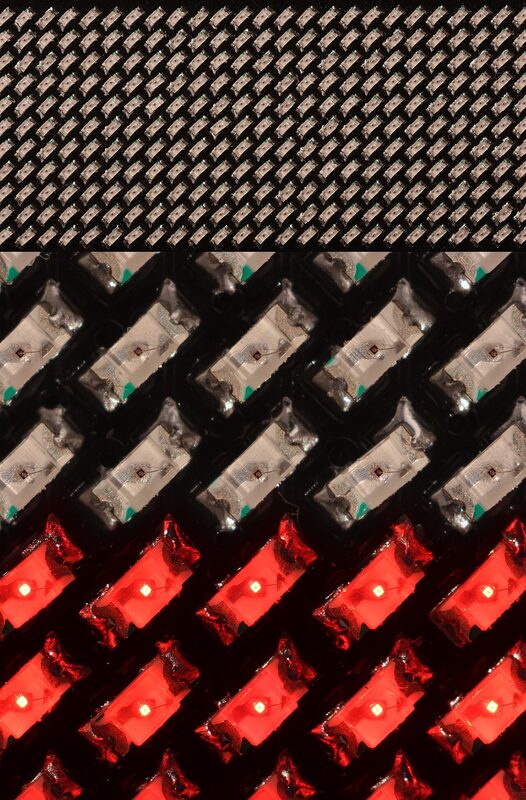
M5Stack has added a new controller to its lineup, and this one has no LCD. The Core Matrix (SKU C158) uses a 16x16 grid of white LEDs as its display, 256 LEDs in all, and puts it on a controller built around Espressif's ESP32-C61HR8. That chip gives it 2.4 GHz Wi-Fi 6. The board also carries a BMI270 6-axis IMU, a microSD slot, a passive buzzer, three user buttons and a 30-pin M5-Bus. CNX Software, which covered the board on 9 November 2026, says it appears to be an update to M5Stack's ATOM Matrix: a small, self-contained device whose main output is an LED grid, now with a larger 16x16 monochrome matrix and a Wi-Fi 6 SoC.
CNX Software reports the board, sold as a development kit, at $29.99 on AliExpress, excluding shipping and taxes, and says it is also available on the official M5Stack store. We could not check the store price ourselves, because the shop page rate-limited our requests, and M5Stack's documentation page does not list one. The specifications below come from M5Stack's own documentation page for the product, with extra detail from CNX Software's coverage and Espressif's product page for the SoC. Each figure is attributed to its source.
The silicon: ESP32-C61HR8
M5Stack's documentation lists the processor as an ESP32-C61HR8, a 32-bit RISC-V single-core part running at 160 MHz, with 16 MB of flash and 8 MB of PSRAM. CNX Software adds the on-chip memory figures, 320 KB SRAM and 256 KB ROM, and says the flash is QSPI.
The ESP32-C61 is Espressif's affordable Wi-Fi 6 part, and its radio is the most notable thing about the board. Espressif's product page says the chip integrates Wi-Fi 6 and Bluetooth 5 (LE). It supports 802.11ax at 20 MHz bandwidth with OFDMA, MU-MIMO and Target Wake Time, and 802.11b/g/n at 20/40 MHz. For Bluetooth, Espressif lists long range via advertisement extension and coded PHY, the 2 Mbps PHY and Bluetooth Mesh 1.1. CNX gives the board's Bluetooth as LE 5.0.
Espressif describes Target Wake Time as the basis of ultra-low power applications. On a TWT-capable access point, the station and the AP can agree on a schedule for when the radio wakes, which is a power-saving feature 802.11ax brings to IoT nodes. How much it saves depends on firmware support and the AP. Neither M5Stack nor CNX publishes TWT power figures for this board.
The display: 256 white LEDs on a TM1680
The display is a 16x16 white LED matrix driven by a TM1680 LED driver, according to M5Stack's documentation, which says it shows device status, event reminders and feedback through icons and simple animations. The LEDs are monochrome white, not individually addressable RGB parts. M5Stack's pin map shows the TM1680 on the same I2C bus as the IMU (GPIO0 and GPIO1), so the SoC pushes frame data over I2C and does not need to bit-bang the refresh. The result is a grid that can show glyphs, a level indicator or a low-resolution animation. It is closer to a status panel than a screen.
Sensors, storage and controls
M5Stack's spec list has a BMI270 6-axis IMU with interrupt wake-up. The interrupt wake-up is the useful detail: M5Stack's pin map routes a BMI270 interrupt wake-up signal to the power-management chip. That fits the tilt, shake and orientation demos that LED-matrix gadgets tend to run, and it also suits motion-triggered loggers.
The rest of the onboard hardware, per M5Stack, is a microSD slot, a passive buzzer, three user buttons and a separate power button. Two support chips handle power and peripheral management: the M5IOE1 and the Stamp Timer Power2 (M5PM1). CNX notes that M5Stack provides dedicated M5PM1 and M5IOE1 driver libraries. M5Stack's pin map shows the microSD power, buzzer, charging control, LED matrix power and Grove 5 V output being switched through the M5IOE1 rather than directly by SoC GPIOs. Neither source gives a free-GPIO count, and we will not estimate one.
Expansion and power
For expansion, M5Stack lists M5-Bus and an HY2.0-4P Grove interface. CNX adds that the M5-Bus is the 30-pin variant and that the Grove port carries I2C on GPIO0 and GPIO1. Both M5Stack and CNX list an MX1.25-4P USB expansion connector. M5Stack says the M5-Bus and Grove interfaces allow connection to M5Stack Modules and other sensor devices. Whether a given module works depends on which signals it expects on which bus pins, so check each module against M5Stack's Core Matrix pin map before buying.
On power, CNX reports 5 V input via USB-C or the M5-Bus, or a 3.7 V external battery through an MX1.25-2P connector. The charging current is selectable between 180 mA (the default) and 650 mA. M5Stack and CNX give two measured consumption figures, both taken at 4.2 V: 8.21 µA in shutdown and 128.06 mA at full load. Neither source says what "full load" includes, for example how many LEDs were lit or whether the radio was transmitting. Treat it as a ceiling for that test condition, not a design number. CNX says the package includes the controller and a 2.0 mm hex key, but no battery. If you add a cell, follow M5Stack's own guidance.
CNX and M5Stack give the size as 54 x 54 x 11.6 mm and the weight as 28.9 g.
Software
M5Stack's documentation page links tutorials for UiFlow2, its graphical programming platform, and for the Arduino IDE. CNX lists the supporting libraries as M5Unified, M5GFX, and the M5PM1 and M5IOE1 drivers. M5Unified and M5GFX are M5Stack's Arduino libraries, so existing M5 code that relies on them may need less porting work. The sources do not say how M5GFX maps onto a 1-bit 16x16 LED grid compared with the TFT panels it normally drives. Firmware authors should expect a different drawing model from LCD-based controllers.
Spec summary
- SKU: C158 (M5Stack)
- SoC: ESP32-C61HR8, 32-bit RISC-V single core, 160 MHz (M5Stack)
- Memory: 320 KB SRAM, 256 KB ROM (CNX); 16 MB flash, 8 MB PSRAM (M5Stack)
- Wireless: 2.4 GHz Wi-Fi 6 (M5Stack); BLE 5.0 (CNX); 802.11ax 20 MHz with OFDMA, MU-MIMO, TWT (Espressif)
- Display: 16x16 white LED matrix, TM1680 driver (M5Stack)
- Sensors: BMI270 6-axis IMU with interrupt wake-up (M5Stack)
- I/O: 30-pin M5-Bus (CNX), HY2.0-4P Grove I2C on GPIO0/GPIO1 (CNX), MX1.25-4P USB expansion (M5Stack)
- Other: microSD, passive buzzer, three user buttons plus power button (M5Stack)
- Power: 5 V via USB-C or M5-Bus, or 3.7 V battery via MX1.25-2P; charging 180 mA default or 650 mA; 8.21 µA shutdown, 128.06 mA full load at 4.2 V (M5Stack, CNX)
- Size/weight: 54.0 x 54.0 x 11.6 mm, 28.9 g (M5Stack, CNX)
- Price: $29.99 on AliExpress, excluding shipping and taxes (CNX, 9 November 2026)
What It Means for Makers
The Core Matrix suits people who want a networked device with an always-visible, glanceable output and no LCD. Examples include desk notifiers, build-status lights, clocks, classroom demos and motion-reactive badges. Compared with a bare ESP32-C61 dev board, it saves you wiring a matrix driver, IMU, buzzer, SD slot and charge management yourself, and it puts all of that in a finished 54 mm case with M5-Bus and Grove for expansion. Educators already using UiFlow2 get a board whose output is easy to see from the back of a room, together with an IMU for physical-computing lessons.
At the price CNX reports, it is also a fairly cheap way to try Wi-Fi 6 features such as Target Wake Time on a single-core RISC-V ESP32. The 8 MB of PSRAM is generous for a part in this class. One caution: the 16x16 white grid is monochrome and low resolution, so the board does not replace an LCD-based controller for anything that needs a real UI.
Price and availability: CNX Software reports $29.99 on AliExpress, excluding shipping and taxes, as of 9 November 2026, and says the board is also available on the official M5Stack store. The package has no battery. We could not confirm the price from the M5Stack store itself, so confirm current price and stock with the seller before planning a classroom or product run around it.
