
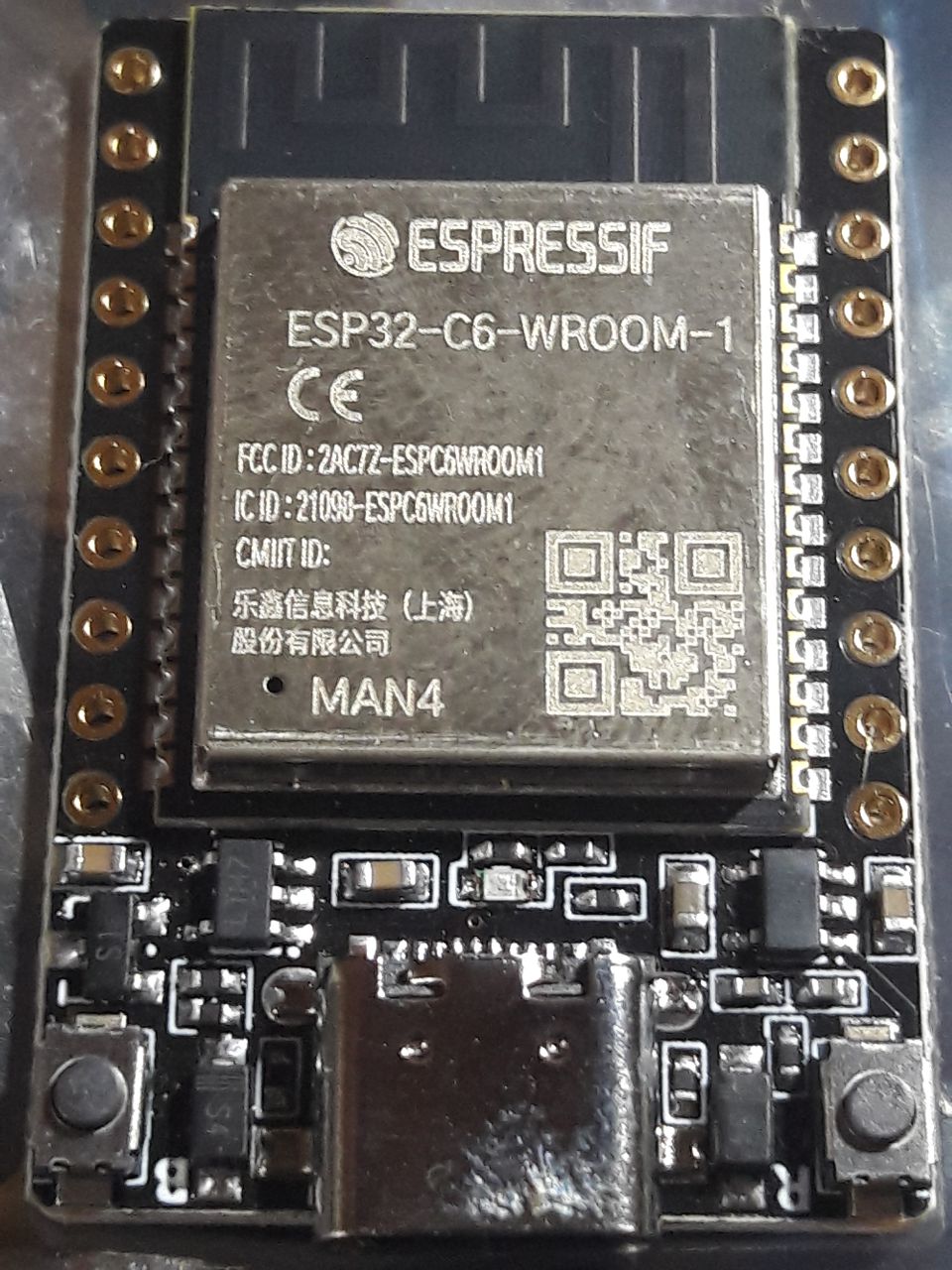
Espressif now sells enough ESP32 variants that "use an ESP32" is no longer a useful answer. The four parts most makers are choosing between in late 2026 have little in common beyond the name: one is a dual-core Xtensa chip with Wi-Fi 4, one is a RISC-V Wi-Fi 6 chip that also speaks Thread and Zigbee, one has no radio at all, and one has no Wi-Fi. This guide sets their specifications side by side, using Espressif's own datasheets (ESP32-S3 v2.2, ESP32-C6 v1.5, ESP32-H2 v1.3 and the ESP32-P4 pre-release v0.7, the versions current as of October 2026), and then works through which one fits which kind of project.
One caution before the numbers. Most dev boards carry a module, not a bare chip, and modules add their own flash, PSRAM, antenna and temperature limits. The figures below describe the chips. Check the module datasheet for the board you actually buy.
The four chips at a glance
| ESP32-S3 | ESP32-C6 | ESP32-P4 | ESP32-H2 | |
|---|---|---|---|---|
| Main CPU | Dual-core 32-bit Xtensa LX7, up to 240 MHz, single-precision FPU | Single 32-bit RISC-V (HP core), up to 160 MHz | Dual-core 32-bit RISC-V, up to 400 MHz (chip rev. v3.x; 360 MHz on earlier revisions) | Single 32-bit RISC-V, up to 96 MHz |
| Low-power core | ULP-RISC-V and ULP-FSM coprocessors | LP RISC-V, up to 20 MHz | LP RISC-V, up to 40 MHz | None listed |
| CoreMark (Espressif) | 1329.92 (two cores at 240 MHz); 5.54/MHz | 496.66 at 160 MHz; 3.10/MHz | 6.92/MHz (dual-core) | 303.38 at 96 MHz; 3.16/MHz |
| On-chip RAM | 512 KB SRAM + 16 KB RTC SRAM | 512 KB HP SRAM + 16 KB LP SRAM | 768 KB HP L2MEM + 32 KB LP SRAM + 8 KB SPM | 320 KB SRAM + 4 KB LP memory |
| In-package memory options | None, or flash up to 8 MB and/or PSRAM up to 16 MB (variant-dependent) | None (QFN40), or 4 MB / 8 MB flash (QFN32) | 16 MB or 32 MB PSRAM; flash is external | 2 MB or 4 MB flash |
| Wi-Fi | 802.11b/g/n, 2.4 GHz, 20/40 MHz | 802.11ax (Wi-Fi 6), 2.4 GHz, plus b/g/n | None | None |
| Bluetooth | Bluetooth 5 (LE), mesh | Bluetooth LE, 5.3 certified | None | Bluetooth LE, 5.3 certified |
| 802.15.4 | No | Yes: Thread 1.3, Zigbee 3.0 | No | Yes: Thread, Zigbee 3.0 |
| Programmable GPIOs | 45 | 30 (QFN40) or 22 (QFN32) | 55 | 19 |
| USB | Full-speed OTG + USB Serial/JTAG | USB Serial/JTAG (full speed, 12 Mbit/s) | USB 2.0 High-Speed OTG + Full-Speed OTG + USB Serial/JTAG | USB Serial/JTAG |
| ADC | Two 12-bit SAR ADCs, up to 20 channels | 12-bit SAR ADC, up to 7 channels | Two ADC controllers | 12-bit SAR ADC, up to 5 channels |
| Stand-out extras | LCD and 8- to 16-bit DVP camera interfaces, 14 touch pins, SIMD instructions | Two TWAI (CAN 2.0) controllers, SDIO slave | MIPI CSI and DSI (2-lane x 1.5 Gbps each), ISP, H.264 encoder, JPEG codec, Ethernet MAC, SD/MMC host | Lowest pin count; Thread and Zigbee without Wi-Fi |
All figures are from the Espressif datasheets listed under Sources. The S3, C6 and H2 datasheets each quote 7 µA in Deep-sleep; the P4 datasheet does not give a single headline figure, so it is left out here.
ESP32-S3: the general-purpose default
If a project needs Wi-Fi, a decent amount of compute and plenty of pins, the S3 is the safe pick. Espressif's datasheet describes a dual-core Xtensa LX7 at up to 240 MHz with a single-precision FPU, a 128-bit data bus and dedicated SIMD instructions, 512 KB of SRAM and 384 KB of ROM. It has 45 programmable GPIOs, though not all are free: the datasheet reserves four as strapping pins and allocates six (or seven, when both in-package flash and PSRAM are present) to in-package memory.
Among the three radio-equipped chips here, the S3 is the only one with a USB OTG controller (full speed) and native camera and LCD interfaces, which is why it turns up on so many display boards. PinoutFeed has covered several recently, including M5Stack's PaperDIY e-paper kits and the OpenMote universal remote.
Two catches. First, its radio is Wi-Fi 4 (802.11b/g/n) on 2.4 GHz only. Second, read the variant table. The chips with Octal SPI PSRAM in the package (ESP32-S3R8, ESP32-S3R16V and the now end-of-life S3R8V) are rated for an ambient range of –40 to 65 °C, against 85 °C or 105 °C for other variants. Espressif notes that enabling PSRAM ECC lifts that to 85 °C at the cost of 1/16 of the PSRAM. For an enclosure in direct sun, that line matters more than the clock speed.
ESP32-C6: Wi-Fi 6 plus Thread and Zigbee
The C6 is the chip for smart-home devices that need to talk to more than one kind of network. According to its datasheet it combines 2.4 GHz Wi-Fi 6 (802.11ax), Bluetooth LE (5.3 certified) and an IEEE 802.15.4 radio supporting Thread 1.3 and Zigbee 3.0, with all three sharing one antenna. The Wi-Fi 6 support has a specific limit: 802.11ax runs in "20 MHz-only non-AP mode," while legacy 802.11b/g/n still supports 20 and 40 MHz channels.
Compute is modest. The high-performance core is a single RISC-V running at up to 160 MHz, with 512 KB of HP SRAM. A separate low-power RISC-V core runs at up to 20 MHz with 16 KB of LP SRAM, so simple sensor polling can continue while the main core sleeps. The QFN40 package exposes 30 GPIOs and needs external flash; the QFN32 variants (ESP32-C6FH4 and ESP32-C6FH8) carry 4 MB or 8 MB of flash in the package and expose 22.
Note what the C6 does not have: USB OTG. Its USB Serial/JTAG controller provides only a CDC-ACM serial port and a JTAG adapter at full speed (12 Mbit/s), so it is not a general-purpose USB device or host controller. On the other hand, it has two TWAI controllers compatible with CAN 2.0 (the S3 has one) and an SDIO slave controller, which the S3 lacks.
ESP32-P4: an application processor without a radio
The P4 is not a wireless chip. Its datasheet lists no Wi-Fi, Bluetooth or 802.15.4 radio, and Espressif's product page says that if an application needs wireless, "any product from the ESP32-C/S series can serve as a wireless companion chip," connected over SPI, SDIO or UART using its ESP-Hosted software.
In exchange, it is the highest-clocked of the four. The HP system is a dual-core RISC-V at up to 400 MHz with 768 KB of on-chip L2 memory, and the in-package PSRAM comes in 16 MB (ESP32-P4NRW16X) or 32 MB (ESP32-P4NRW32X). The media hardware is what sets it apart: MIPI CSI and MIPI DSI, each specified as 2-lane x 1.5 Gbps, an image signal processor, a JPEG codec, a pixel-processing accelerator and an H.264 encoder rated at up to 1080p at 30 fps. It also has USB 2.0 High-Speed OTG, an Ethernet MAC, an SD/MMC host and 55 programmable GPIOs, which Espressif's product page calls a significant increase over any previous Espressif SoC.
Two details catch people out. The current datasheet (pre-release v0.7) covers chip revision v3.x, and Espressif's Chip Revision v3.x User Guide says that revision raised the HP cores' maximum clock from 360 MHz to 400 MHz. Boards built on earlier P4 silicon therefore top out at 360 MHz, so check which revision your board uses. And the P4 has several separately powered IO banks: the datasheet allows 1.65 V to 3.6 V on VDD_IO_0, VDD_IO_4, VDD_IO_5 and VDD_IO_6, so a given board may run some pins at 1.8 V. The board's schematic is the authority there. For an example of what the chip enables, see LakeShark on LilyGO's T-Display P4.
ESP32-H2: Thread and Zigbee without Wi-Fi
The H2 is the smallest of the four, built for battery-powered mesh endpoints. Its datasheet lists a single RISC-V core at up to 96 MHz, 320 KB of SRAM, 4 KB of LP memory and 2 MB or 4 MB of flash inside the package (ESP32-H2FH2S and ESP32-H2FH4S). There are 19 programmable GPIOs, three of which (GPIO8, GPIO9 and GPIO25) are strapping pins.
The radio is Bluetooth LE (5.3 certified) plus 802.15.4. The datasheet lists Zigbee 3.0 and "Thread 1.4" support, while Espressif's product page says the chip has been certified as a "Thread-Certified 1.3.0 Component" and a "Zigbee-Compliant Platform." There is no Wi-Fi. Espressif's suggested pattern for a Thread border router or a Matter-Zigbee bridge is to pair the H2 with one of its Wi-Fi SoCs. Toolchain support beyond ESP-IDF is growing; TinyGo, for example, added ESP32-H2 support in version 0.43.0.
Electrical rules that apply to all four
These are 3.3 V parts. Each datasheet gives a recommended supply of 3.0 to 3.6 V for the main power pins, and the S3's DC table puts the maximum high-level input voltage at VDD + 0.3 V. A 5 V logic signal is outside that range, so use a level shifter when you connect 5 V peripherals.
Drive-strength figures need care. The S3 datasheet lists a high-level source current of 40 mA (at VOH ≥ 2.64 V) and a low-level sink current of 28 mA (at VOL = 0.495 V), but both are typical values measured at the strongest drive setting (PAD_DRIVER = 3), with no minimum or maximum given. They describe what a pin typically delivers under those test conditions, not a guaranteed per-pin rating, so don't design a load around them.
What It Means for Makers
The choice usually comes down to the radio you need, then the compute:
- Wi-Fi gadget, display, camera or USB device: ESP32-S3. It has the broadest board ecosystem, USB OTG, camera and LCD interfaces, and two cores. Check the temperature rating if you choose an Octal-PSRAM variant.
- Smart-home device that has to join Thread, Zigbee or Matter-over-Thread as well as Wi-Fi: ESP32-C6. It's the only chip here with all three radios on one die.
- Battery-powered Thread or Zigbee sensor, switch or tag: ESP32-H2. It has fewer pins and less compute, and no Wi-Fi, which is the point.
- Touchscreen HMI, MIPI camera pipeline, video encoding or anything needing high-speed USB or Ethernet: ESP32-P4, plus a C-series or S-series chip if it also needs wireless.
Espressif's line-up keeps growing. The dual-band ESP32-C5 is already on boards such as M5Stack's ToughC5, and the ESP32-S31 is starting to reach hobby hardware. Neither is covered in the table above. For the four chips here, the datasheet versions cited are the reference, and Espressif revises them; if a number matters to your design, check the current revision before you commit to a part.
Sources
- ESP32-S3 Series Datasheet v2.2 (Espressif)
- ESP32-C6 Series Datasheet v1.5 (Espressif)
- ESP32-P4 Series Datasheet, pre-release v0.7 (Espressif)
- ESP32-P4 Chip Revision v3.x User Guide (Espressif)
- ESP32-H2 Series Datasheet v1.3 (Espressif)
- ESP32-P4 product page (Espressif)
- ESP32-H2 product page (Espressif)
